Return to the Zeiglers
Cut to the outside of Zeigler’s house. Then to the inside, Bill walking Zeigler’s assistant down the same hall in which he’d entered for the party. The decorations are still up in the area with the stairway, though only the Christmas tree and the cascade of white lights are lit. As they continue down another hall, we see the same style of bow decorations hanging as had been at Sharky’s (which was also the Rainbow costume shop). We had just a glimpse of these bow decorations in the scene at the first party in which Nuala and Gayle and Bill had been flirting, observed through a background door, down the hall, barely distinguishable through surrounding lights.

Passing under the bow decoration which had been seen at Sharky’s
He’s ushered through a left door toward the middle of the hall into Zeigler’s pool room/library which is lined with books, reminding somewhat of the library in which the man with the tricorner hat (Zeigler) had directed a model over to Bill’s side.
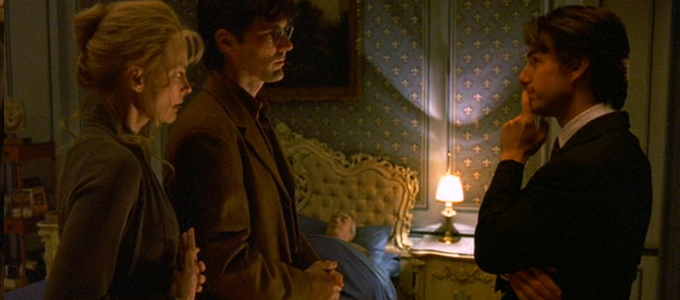
Zeigler greets him warmly, saying he appreciates his coming and that he’s sorry to drag him out. Bill says he was out anyway. Zeigler offers him a drink and Bill asks for some scotch. (In the screenplay ithe drink is identified as Napoleon 1935.) Bill tells him it was a terrific party and that he and Alice had a wonderful time. As they approach the red billiard table, overhung with green lights, Bill asks if he had been playing and Zeigler says he was just knocking a few balls around. When Bill says it’s good Scotch, Zeigler says it’s 25 year old and offers to send over a case. Bill declines. Zeigler insists. Bill emphatically declines. Zeigler laughs, playing with the cue ball, asking him if he feels like playing, and Bill says no, he’ll watch.

Zeigler says no, hesitates, says listen, uh, Bill, the reason he asked him to come over was he needed to talk to him about something. Awkward. But he has to be completely frank.
“What kind of problem are you having?” Bill asks.
Zeigler says it isn’t a medical problem, crossing before a large model of a ship. He says it concerns Bill.
Cut to Bill staring at Zeigler.
Cut to Zeigler. He says he knows what happened the night before, and he knows what’s been going on since then, and he thinks Bill has the wrong idea about one or two things.
Bill stares in horror, drops his head, smiles, then asks what he’s talking about.
“Please, Bill, no games. I was there, at the house. I saw everything that went on.” Zeigler asks Bill what the hell he thought he was doing. He couldn’t begin to imagine how he heard about it, much less got himself through the door. Then he remembered seeing him with the “prick piano player, whatever his name was, at my party” and it didn’t take much to figure out the rest.
Bill says it wasn’t Nick’s fault, it was his.
“Of course it was Nick’s fault. If he hadn’t mentioned it to you in the first place none of this would have happened.” He says he recommended the cocksucker to those people and he’s made him look like a complete asshole.
“What can I say?” Bill asks. “I had absolutely no idea you were involved in any way.”
“I know you didn’t, but I also know you went to Nick’s hotel this morning and talked to the desk clerk.”
Bill asks how he knows and Victor admits he had Bill followed. He says he is sorry, he owes him an apology but it was for his own good. He says he knows what the desk clerk told him but what he didn’t tell him was that all they did was put Nick on a plane to Seattle and by now he’s back with his family banging Mrs. Nick.
Bill mentions Nick was bruised.
“Ok, he had a bruise on his face. That was a hell of a lot less than he deserved.” Victor goes on saying he doesn’t think Bill realizes the trouble he was in. “Who do you think those people were? Those were not just ordinary people. If I told you their names…I don’t think you’d sleep so well.”
Bill asks if it was the second password that gave him away.
Yes, finally, but not because he didn’t know it. Because there was no second password. It didn’t help that most arrive in limos and he showed up in a taxi. Or that when they took his coat they found the receipt for the rental house in his pocket made out to you-know-who.
“There was a woman there who tried to warn me.”
Victor says he knows.
“Do you know who she was?”
Victor says he does. A hooker. “Sorry. That’s what she was.”
A hooker.
Victor says suppose he told him that everything that happened to him there, the threats, the girls’ warnings, the last minute interventions, what if he said that all of that was staged, a kind of charade, that it was fake.
“Fake.”
Yes, fake.
Bill, having seated himself on the sofa, bent over, beats his clasped fists against his forehead, asking why they would do that.
In plain words? To scare the living shit out of you. To keep you quiet about where you’d been, about what you’d seen.
Bill slaps his hands. He brings out of his pocket the newspaper article about the girl’s death and asks if Victor has seen it.
Victor advances, takes it. Folds it up and hands it back, saying he has.
Bill says he saw her body in the morgue. “Was she? Was she the woman…”
Yes.
“Well, Victor, maybe I’m missing something here. You called it fake, a charade, do you mind telling me what kind of fucking charade ends with somebody turning up dead?”
“Okay Bill, let’s cut the bullshit. You’ve been way out of your depth for the past 24 hours. You wanna know what kind of charade? I’ll tell you exactly what kind. That whole playacted, take me, phony sacrifice that you’ve been jerking yourself off with had absolutely nothing to do with her real death. Nothing happened to her after that party that hadn’t happened to her before. She got her brains fucked out, period. When they took her home she was just fine. And the rest of it is right there in the paper. She was a junky. She OD’d. There was nothing suspicious. Her door was locked from the inside. The police are happy. End of story. Come on. It was always going to be just a matter of time with her. Remember, you told her so yourself. You remember, the one with the great tits who OD’d in my bathroom. Listen, Bill, no one killed anybody. Somebody died. It happens all the time. Life goes on. It always does. Until it doesn’t. But you know that, don’t you.”
In the screenplay, Victor instead describes Amanda thusly:
Bill, are you so sure she was the kind of woman for whom the things you imagined were actually a sacrifice? If she attended these affairs and knew the rules so well, do you suppose it would have made any difference to her whether she belonged to one of the men, or to all of them? Bill, she was just a thousand-a-night hooker, no more, no less.
Victor’s costume at the play, the tricorner hat and the mask, is exactly as that observed in a statue in the theater district of Milton Keynes, paired with another female figure in a Napoleonic hat. The 1995 sculpture, “Dangerous Lliaisons” is by Philip Jackson and based on the Maschera Nobile.

The Tricorner Hat
Before I move along, I’d like to note that the notion that Amanda’s death by OD, rather than a murder, is given as proven by her door having been locked from the inside. “The Shining” had the scene in which Jack was locked in the storage room (pronounced story room at one point) and then is released by what may be a supernatural force. Much has been conjectured about whether he was released by such a force or of there is a rational answer. We’ve here another such mystery, the how of Amanda’s death given as confirmed entirely by that door being locked on the inside, Victor insisting that this proves her death was accidental. The viewer is left to judge whether or not Victor can be trusted.
Bill Returns Home
Cut to Bill’s mask on his pillow, Alice asleep beside it.

The light suggests Alice’s face is masked

Bill enters the apartment, the fleur de lis decoration on the blue hall wall outside. He removes his coat, enters the living room with its lit tree, presents all around. He cuts off the lit tree. Goes into the kitchen. Takes a beer from the refrigerator and sits at the table. Dissolve to his opening his bedroom door, looking slightly inebriated. He sees the mask. Stares. He lowers himself to the bed and begins to sob. His crying wakes Alice, whose expression is at first bizarrely inscrutable, mask like, distant, devoid of any emotion, even surprise. He leans down and rests his head on her. “I’ll tell you everything,” he says, she stroking his hair. “I’ll tell you everything. I’ll tell you everything.”
Only after the extinguishing of the multi-colored Christmas tree lights do we have this break down with Bill offering to tell Alice everything.
Cut to Alice, smoking, dressed in a blue sweater, eyes red as if with tears, sitting on the sofa. Bill sits across from her on the other sofa. Dawn. Alice says Helen will be up soon and she’s expecting them to take her Christmas shopping.

Next a toy store or toy section of a store. “Stairs to all floors” sign. The decorations are white stars on fields of blue and red. They pass by a sales display of games called “The Magic Circle”, a man scattering bubbles above attracting interest to the display via the many bubbles. Helena runs ahead and looks at a doll baby carriage saying how pretty it is, she could put Sabrina in there. “It’s old fashioned,” Alice says, dressed in a camel color coat the same style as had been worn by the bald individual who had been following Bill, her hands tucked into its pockets as had been that individual’s. A tiger doll or puppet sits on a box behind the carriage taking us back to Domino’s apartment, outside of which had been the baby stroller, inside of which had been the toy tiger.
The decorations are white stars on fields of red and blue.
Helena runs ahead and picks up a large teddy bear, saying she hopes Santa gets her one. Tigers hang nearby. Alice looks at the price tag and says he’ll have to wait and see. They pass through multiples of stuffed animals, teddy bears.
And, really, thinking in terms of a deluge and rainbow and the idea of multiplying afterwards, the toy store with its numbers of stuffed animals etc. Interestingly, the multi-colored Christmas lights and tree are absent here, as noted above, the store just being those stars on fields of red and blue.
“Alice, what do you think we should do?” Bill asks her.
“What do you think we should do?”
“Look, mommy!” Helena holds up a boxed Barbie doll in a ballerina costume. Numerous such dolls in boxes below.
“What do I think? I don’t know. I mean, maybe.” They stop before a wall of tigers. “Maybe, I think, we should be grateful. Grateful that we’ve managed to survive through all of our adventures whether they were real or only a dream.”

“Are you sure of that?”
“Am I sure? Only as sure as I am that the reality of one night, let alone that of a whole life time, can ever be the whole truth.”
“And no dream is ever just a dream.”
“The important thing is we’re awake now, and hopefully for a long time to come.”
“Forever.”
“Forever.”
“Forever.”
A trinity of forevers, just as the twin girls in “The Shining” had invited Doc to play with them forever and ever and ever, and Jack had told his son that he wanted to live at the Overlook forever and ever and ever. OD or OVD is a word that means continuance, eternity, life everlasting. It comes from a word meaning to repeat. My reasoning is that we have not only the word here, emphasized in the repeating aspect, inflating to the sense of eternity, but it perhaps also is referred to in the scenes with Sandor who references Ovid (Alice responding didn’t he die crying his eyes out in a place with a bad climate, referring to the flood) but also the overdose of Amanda which is in the film referred to as an event the recurrence of which was inevitable.
“It’s no use, that word,” Alice says. “It frightens me. But, I do love you. And, you know, there is something very important that we need to do as soon as possible.”
“What is that?”
“Fuck.”
It should be realized we have no idea what Bill told Alice. “Everything,” he said, but what was his vision of what he’d observed as opposed to what Kubrick has presented us or what we observe? I’ve no doubt that in the end we’re left to know no more than the once knowledgeable Bill, or Alice.
This Will have to do for my wrap up
The flooding that Bill experiences in the film seems to have to do with a stripping away of, let’s say, some attribute of the world of Malkuth or Assiah (the material worlds in cabbalistic lore), or an elevation into one of the higher worlds, so that he is suddenly immersed in a landscape of denuded formula, of signs repeating and expanding upon themselves. But I’m not a Cabbalist so what do I know. This is just how it seems to me from the little of which I’m aware.
There is perhaps a reference in 2001 that neatly ties in and strengthens my position. Dave Bowman has been drawing pictures of the crew in hibernation. HAL asks to see them and while Dave shows them to him HAL begins to question him on how he feels about things, asking if he has second thoughts. HAL says his reason for inquiry is difficult to define, that perhaps he is simply projecting his own concerns (just as any one of us can project wildly upon Kubrick’s films) but he is unable to free himself of the suspicion that there are some “odd things” about the mission and he’s sure Dave will agree with the truth about this. “Certainly no one could have been unaware of the very strange stories floating around before we left,” HAL says, and as he says it, on one of the computer screens is MEM, which I think refers to the Hebrew letter M and the waters. The strange stories floating around in connections with the waters is very akin to what has happened here.
It is at this point in the inquiry that HAL breaks off and predicts a fault in the AE35 unit that will go 100 percent failure in 72 hours, but says that there will be no indication of this until the time that it fully fails. The computer, which has full knowledge of the mission, whereas Dave Bowman doesn’t yet, is acting as a sort of oracle on the failure of the communications device. But is HAL in error, as the folks back on earth say he is, or are conditions different out here in space so that the result he gives is different from his twin computer. Or is HAL simply already plotting the death of Frank Poole and Dave Bowman. Whatever, this is the turning point that will ultimately result in Bowman’s confrontation with the monolith at Jupiter leading to the long sequence of brightly colored lights that seem to convey intelligence, the close-ups of Dave’s iris wrapping round his pupil while this is ongoing, and the popping out the other side in the French Baroque bedroom and bath where he will progress through his final leg of the journey toward rebirth.
The fault in Bill’s life which seems to launch him into the flood is perhaps his forgetting of the name of Roz or, conversely, having been made aware of it, which is going to be in respect to his failure to really see his wife, to look at her, which has to do with the world at large and his own complex nature. RZ is “to attenuate” to hide, a mystery, secret. Roz is his babysitter’s name, the one for whom he’s left the numbers. Rosa is the name of the Nathanson maid. His experiences on the street beginning at the time of his seeing the couple kissing under the closed rosebud, one could think in terms of matters sub rosa. By the time we reach Domino’s apartment, the flood of signs well under way, we have “maid’s day off”, the place a mess of dishes and old food. At the costume shop we can see across the way the sign Eros and though there are historical warpings, present day myth has, according to Wikipedia, Aphrodite giving the rose to her son, Eros, who gives it then to Harpocrates, who has eventually become associated with the god of silence, “to ensure that his mother’s indiscretions (or those of the gods in general…) were kept under wraps”, which fits in with this movie as well as long as we don’t think in terms of personality. At the time of the winter solstice Bill is well on his way to Somerton, his wife also effected by the flood and providing her own view of the universe and its repetitions which seem to reach for novelty in evolutionary ways, which occur via multiplication. By the end of the film Bill and Alice stand in the toy store, amongst a suggestion of innumerable stars and all the games of magic circles, the creatures of the ark multiplying all about them, counting themselves as now awake and lucky to have survived their adventures, ruminating on mysterious natures of reality of which they were previously unaware.
The end story remains what is the nature of love and fidelity in this big universe and where does it fit in.
The Zeigler’s Party
Naval Officer, Marion
Domino, Sonata Jazz, Rainbow
Somerton, Alice’s Dream
Nick’s Hotel, Rainbow, Somerton
Marion, Domino, Sharky’s, the Hospital
Zeigler, Home, the Toy Store
Revisiting Marion Nathanson
Exterior shot of Harford’s apartment building at night, much the same as when we first saw the building. Inside, Bill is returning home, he goes toward the living room, his daughter calling her greetings. He goes into the dining room where his wife and daughter are at the table and asks if there were any calls for him. She says that Dr. Sanders and Shapiro called.
His daughter is doing school work, books spread out over the table, including a book titled “Carlos”. One book is open and she says she got “all of them right”. Alice yawns and asks if he’s hungry. He says he is, sort of. Alice asks if he wants to eat at 7 and he says to make it earlier as he has some appointments, that he has to go out again. His daughter asks if she’s going to get a puppy for Christmas and he says they’ll see about it.

“But he could be a watchdog,” his daughter says.
A watchdog? Interesting, considering the admonishment given Bill that his family could be endangered by his inquiries. But Bill is also, in a sense, a watcher throughout. This idea returns at the end in a scene with Victor. On one level it could have to do with Bill’s being told he’s knowledgeable but missing out on much, as if experience. On another level there’s the idea of the double dialogue going on around him, the signs playing out physically.
“We’ll see.”
He passes by a candelabra holding 7 red candles, entering the kitchen. As he goes to the refrigerator (recall that he’d originally left the phone and pager numbers on it for Roz) he hears his wife doing a math problem with Helena.
“Joe has two dollars fifty and Mike has one dollar and seventy five cents. Joe has how much more money than Mike?”
Bill stops with his drink in hand, turns and looks at the two.
Alice asks if it will be subtraction or addition and Helena decides subtraction.
We hear him replaying his wife’s confession of her dream in his head, that there were hundreds of people around them and everyone was fucking and then she was fucking other men.
She sees him staring at her and she smiles back. He smiles, strained, in turn.
“So many, I don’t know how many I was with.”
Remember that Carl was a math professor, a scholar of numbers.
The meaning of IVSPh (Joseph) is “let him add” or adding.
MNH or MNA is to count, number.

Cut to Bill’s office, the camera looking toward a hall beyond the counter on its left, a security camera above and a warning sign that states there are security cameras on the premises, reminding of the camera at Somerton and Helena’s asking for a puppy watchdog. A sign about payment can be seen on the wall beside the counter. The camera pans right, over the counter, to the waiting area and the lit Christmas tree.

Cut to Bill in his office, seated behind his desk, hand to chin, envisioning again the naval officer and his wife. He picks up the phone and makes a call.
The phone in the Nathanson apartment rings, Carl answering. He says hello several times. Bill hangs up.
But he’s made a connection.
The Return to Domino’s Apartment
Cut to a cab pulling up before the prostitute’s building.

Bill gets out, wishing the cab driving a Merry Christmas. Another woman passes with a GAP bag. A box in hand he enters the building, passing a woman who carries a large box that looks much like one that had been carried past Rainbow earlier. Bill’s box appears to be a box of pastries.


Inside he rings the doorbell. A woman answers through the door. “Domino?” he asks. The woman replies, no, it’s not her, and when queried if she’s expecting her back soon she says no. Looking somewhat defeated, perplexed about what to do, Bill says he has something for her and can he leave it? The woman, saying sure, opens the door, and smiles upon seeing Bill in his nice clothes, unchaining the door. She wears a blue work shirt, her hair up, a blue skirt with flowers. She asks if she can say who the gift is from. Just tell her it’s from Bill. “You’re Bill?” she says. “The Bill? The doctor who was here last night?” He says he supposes he is and she replies that Domino said how nice he was.
“Did she?”
She nods and invites him.

One wonders what in the world has happened to the Christmas tree which looks pretty beaten up compared to the previous evening.
He advances to the kitchen in front of her and as he removes his jacket before the yellow kitchen table (now cleared) she squeezes her body past him invitingly, saying her name is Sally.


The rainbow on the lens
“Helloooo, Sally.” Bill says, they flirting with each other. He asks when Domino can be expected back, a blue half circle shape appearing on the camera lens in the lower left hand corner. “No idea?” No. “She may not even be coming back,” Sally says. “She may not even be coming back,” Bill repeats, unbuttoning Sally’s shirt. Sally leans her forehead against him, hesitating, this rainbow in the lower left corner, and says there’s something she should tell him, acting as if she’s struggling against arousal. She pushes Bill away and has him take a seat. “I don’t quite know how to say this,” she says. “Don’t quite know how,” Bill says.
Note that Bill is only repeating everything that is said to him. We’d had the signs being doubled physically. Now Bill, returning to Domino’s apartment, only repeats everything that is said to him. At least up to this point in the conversation where a surprise turn is taken and he is astonished, compelled now to react emotionally.
Sally continues on to say that considering that he was with Domino last night, it’s only fair to tell him that Domino got the results from the blood test that morning and they were HIV positive.
Bill sits back. “HIV positive.”
“Yeah.”
He stares. Blinks. “Well,” he says, he’s very very sorry to hear that.
“It’s absolutely devastating,” Sally says and asks if she can offer him a cup of coffee.
Bill says no thank you, that he better be going.
Perhaps he remembers that earlier that morning, at Gillespies, he had used his doctor credentials as a password to try to get to Nick, and failing, had said that he had a message to give him about some medical tests.
Bill, in a sense, returning to the events of the previous evening, is attempting to converse with them. He is making inquiries. But a scared Nick has been sent away, bruised, and a devastated Domino will not be returning.
Sharky’s

A nearly empty street, Bill walking down it.
He passes a garbage can marked 80 then two lit phone kiosks. He looks down, back, and across the street sees before a building, the Nicon House, a man in a beige coat who he seems to think may possibly be following him. There is a one way sign pointing the direction in which they both walk.
The Musica Ricercata plays.
On his side of the street he passes 343. Passes a sign on a door reading FINDINGS. The number 30. Past an awning reading (212) 555-7686. It is a diamond jewelry place. Passes 37. 38. Passes a postal box that bears the same graffiti as had the one before Nick Nightingale’s hotel and the Rainbow shop. Passes Val Dor Ltd, a pearl importer. He looks across the street and now the man is walking before building 23, the Donnelly House, another man passing him going the opposite direction.

We see Bill turn a corner, a delicatessen with bright green awning across the street. He passes by a restaurant lit inside with strands of white lights, outside a sign that reads “For sale, vital, 212-353-3005″. He passes by another postal box, a C&P Cleaners shop with same day cleaning, wash and fold service, 14. He looks back and sees the bald man in the beige coat rounding the corner behind him.

He speeds up, frightened, and before address 237, a restaurant decorated with multicolored lights, he waves for a cab, fearful.
We then see him from another view, waving for a cab, on Wren street. He is at an intersection where a cross street dead ends into Wren, perpendicular him, and at the end of that street is the neon green awning of a delicatessen.

He sees a cab round the corner from the left, onto the side street, crosses toward it. Runs. A passenger gets out but the cab driver yells “Off Duty” at him and takes off and leaves him. Across the street is “A Hint of Lace” next to a “Nails” shop. We see the restaurant he was standing before when hailing the cab was the Verona Restaurant.

A stop sign behind him seems to be marked with the graffiti CMB. He continues down the cross street away from Verona, a Nails shop on the opposite side now and the man in the beige coat appears at the corner, standing next to A Hint of Lace. The man in the beige coat stops and stands still as Bill stops before a manned news kiosk. Cut to a side view of Bill watching the man. Cut to the man on the corner and we see he’s at the intersection of Wren and (perhaps) Miller streets (but it may not be Miller). Cut back to Bill who picks up a newspaper and purchases it. Cut back to the bald man crossing the street to Bill’s side. Again, he stops and stares at Bill. Then he walks on.

Verona is Veronica, meaning “true image”. The story of St. Veronica has her wiping the face of Christ with a cloth and thus recording a true image, an icon of him. She’d offered the cloth to him as he stumbled on the way to his crucifixion.
The Verona’s address is 237, which had been the room number of the maze-like hotel in “The Shining” which served as setting for some horrifying events, the true nature of which could never be divined.
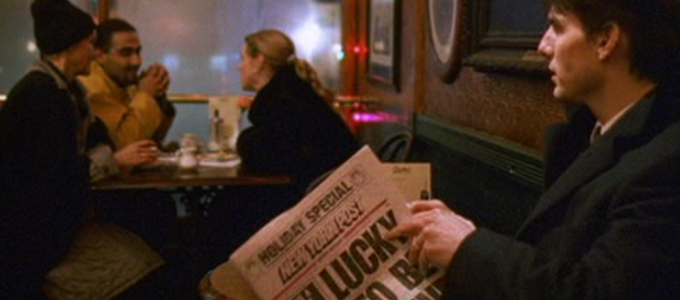
Newspaper in hand, Bill turns and continues down Wren, towards the green delicatessen, and is indeed going the opposite direction from which he initially came. At the middle of the block he turns toward a coffee shop with a bright green awning over its stairs, multicolored Christmas lights decorating, and goes inside. Inside we see it reads Sharky’s. He passes under a Christmas decoration shaped like a bow with two candles upon it.
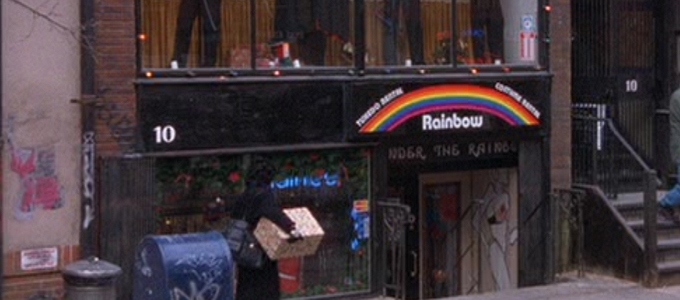
If we’ve been paying careful attention we are aware that the building with the green awning that holds Sharky’s is the same as that which had held the Rainbow costume shop, which was observed as an unlit building down the street from where Bill met Domino, and was a building with a green and white striped awning next to where Bill was slammed into a car by the frat boys.

The bow that is also at Victor’s
He enters the coffee shop, in which Mozart’s Requiem Mass is playing, approaches the bar and orders a cappuccino.

Just as the globes of light on the tables at the opposing Sonata had given the impression of stretching on into infinity, so do the globes of ceiling light here, reflected in the windows, give the same impression, as if stretching into the street and connecting Sharkeys with the Sonata.
He takes a seat under a large portrait of a woman. We see on the back of the newspaper “Cool as Ice” and “Lucky to Be Alive” reads the cover under “Holiday Special”.

The paper open, we see a headline reading “Party” on the right, but what catches Bill’s attention is an article on the lower left page, “Ex-beauty queen in hotel drugs overdose”.
Above it is a picture with a caption that reads “Derailed” showing cops taking an accused bank robber, Anthony Norman, away after his surrender, ending a hostage drama. Also the last sentence of the above story reads, “We have to have no-tolerance for violence.. . even this mental violence.”
A former Miss New York was (reported/admitted?) in New York Hospital in critical condition after a drug overdose, police …. said.
Amanda Curran, (can’t tell age), was found unconscious in her room at the Florence Hotel by security personnel after her agent asked them to check on her be- Hotel by security personnel after her agent asked them to check on her because he’d been unable to reach her by phone.
Workers at the Florence told police she had not been seen since 4 a.m., when she returned to the hotel accompanied by two men. The staff said the men seemed to be holding a giggling Curran upright as they brought her into the posh hotel.
Police have been unable to locate the two men, but a police spokesman said they did not suspect foul play in Curran’s overdose.
“We don’t believe there has been any crime against Miss Curran, but we would like to talk to these two men to see what they can tell us about her final hours” before she was discovered, the spokesman said.
Officials decline to say what drug or drugs Curran OD’d on. It was unclear if there was anyone in the room with her at the time she ingested the drugs. her at the time she ingested the drugs.
Her sister, Jane Curran, told The Post, “Her overdose must have been an accident. Mandy and I were as close as sisters can get. We didn’t have any secrets. If there had been anything wrong, she would have told me.”
Jane, a (something year old) perfume (something) said that her sister was emotionally troubled as a teenager but had managed to put it behind her.
“She’d undergone treatment for depression in her teens, but that was a long time ago.”
She said that her sister was not totally satisfied with her career, but was still hoping to turn her beauty pageant success into an acting gig.
“Things hadn’t gone as well as she’d expected after winning the Miss New York title, but she was considering several television offers.
“She has many important friends in the fashion and entertainment worlds. “She has many important friends in the fashion and entertainment worlds and she believed she’d break through in the end. It was just a matter of time.”
After being hired for a series of magazine ads for London fashions designer Leon Vitali, rumors began circulating of an affair between the two.
Soon after her hiring, Vitali (illegible) insiders were reporting that their boss adored Curran — not for how she wore his stunning clothes in public, but for how she wowed him by taking them off in private, seductive solo performances.
Leon Vitali played the part of the Hierophant in the film.
Several lines are doubled in the article.
The Hospital
Cut to the hospital’s exterior. Then from the inside, through the large revolving doors, Bill’s cab arriving. Entering he goes to the information desk, shows his card, says one of his patients had been admitted and asks for her room number. He’s told she died that afternoon, at 3:45.

Next, Bill is being ushered to the morgue. Inside, all the tables are empty. Amanda’s body is taken out of locker 10 for him to view. He hears in his head, “Because it could cost me my life.” He draws close, gazing on her, examining her face. After a little too long he withdraws.
Then he is walking towards the camera down a hospital hall, brightly colored paintings lining the white wall to the right, the wall to the left yellow, the wall beyond red. His phone rings. Passing Admissions he says yes it’s Dr. Harford. “Tonight? Oh, no, no, no, that’s okay. Please tell him I’ll be there in around 20 minutes.”
We are led to believe that the woman in the morgue is Amanda, that’s the set up in the film, but the woman looks slightly different from the Mandy who was in Victor’s bathroom. Her features look slightly different. In the screenplay Bill asks Ziegler later if it was Amanda, saying he went to the morgue and couldn’t tell.
Next: Zeigler, Home, the Toy Store
The Zeigler’s Party
Naval Officer, Marion
Domino, Sonata Jazz, Rainbow
Somerton, Alice’s Dream
Nick’s Hotel, Rainbow, Somerton
Marion, Domino, Sharky’s, the Hospital
Zeigler, Home, the Toy Store
Nick Nightingale’s Hotel

Fade in on the street. Bill emerging from a taxi (7P94), returning to the Sonata Cafe which is closed and gated. The ad on top of the cab reads DKNY EYES. We see behind the earlier sewing thread sign and that above it the building reads Thread Mills. People walking along carrying wrapped packages and a person has a GAP bag. As he approaches the Sonata Cafe again, with the guitar sign above it, just as when he last visited it, a man with a guitar passes to the right, wearing red and black plaid shirt. Bill finds the Sonata Cafe gated and locked.

He enters Gillespie’s Diner next door and learning from the waitress that Nick Nightingale comes in there, and that she knows his address, tries to get her to tell him where he lives. He even shows her his doctor card but she says no. So finally he tells her it’s a matter of medical tests and that Nick will want to know about them as soon as possible.

The waitress wears a pink shirt and a necktie. A necktie is perfectly normal on a woman but I think here is indicative of gender reversals.
Bill now is encountering gates closed to him after entering Somerton under false pretenses. And yet Bill was certainly enticed to Somerton.
We see him pass by Artini’s and enter Hotel Jaso…. (can’t see its full name) at building number 143. More people with packages and a person with a GAP bag. The exterior light globes on which we see the number 143 remind of the globes on the tables in the Sonata Cafe, and further of stone globes that had been on the gate at Somerton.

The clerk at the reception desk, obviously gay, eyes him up and down appreciatively and asks how he can help him, but when Bill asks for Nick Nightingale’s room, he’s told he already checked out around 5 in the morning, leaving no forwarding address. Bill asks if he noticed anything unusual about him. The clerk asks, “Hey you’re not five 0, are you?” Bill says no, that he’s an old friend, a doctor. “Really?” the clerk replies, interested. And Bill shows him his medical card. “It’s funny you should ask that question, Bill” the clerk says, allowing there was something strange about the way he left. He came in at 4:45 with two big guys, well dressed and well spoken, but not the kind of people you like to fool around with. And, he had a bruise on his cheek and looked a little scared. One of the men settled his bill while the other took him up to his room. When he was leaving, Nick tried to pass him an envelope but the men wouldn’t allow it, saying that any mail or messages for him would be collected by someone properly authorized to do so then took him off in a car and he hasn’t a clue where they went.
Bill says he appreciates it and leaves and the clerk says “any time”.
The gay man recalls Bill having been targeted as a “faggot” the previous evening, after his visit with Marion. A switch hitter. And here we have the gay man obviously attracted to Bill.
Big guys. This comes up a number of times, the big guys who appear to act as bullies or constrainers. Giants are also associated with the NPhL, fallen, overthrown ones, or tyrants. May fit with the film in the context of the mythic story of the rainbow/flood.
Speaking of the mail, if one pays attention to the mail receptacle boxes, we will see them now bearing identical graffiti, appearing to be the same box from place to place.
The second visit to the Rainbow costume shop

Now Bill goes to the Rainbow store to return his costume, a shop selling Murato paints just beyond, which is the store before which he encountered the prostitute, and we are able to see on it in large letters MANNING and below that BOWMAN. A woman passes with a large box. He goes up the side steps and enters into the store.

We see that one of the mannequins in the window is no longer wearing red, as it had been the previous evening.

We see that the stance of the mannequin beside the security gate is different from the previous evening.
Where there were shirts beside the mannequin beside the security gate, there are now shoes, and a second counter is located there, whereas the previous evening there had only been one counter located before the wall cases holding the suits.
The owner greets him, “Oh, the doctor” and asks him if his outfit was a success. He says it was. The owner informs Bill he’s forgotten the mask. “Maybe you left it at the party,” he suggests. Bill thinks a moment then says he doesn’t think so, that he must have lost it, and asks it to be put on the bill.
It was 150 for the rental, then the 200 and 25 for the mask. 375. As Bill prepares to pay, cut to the side and through the door that leads to the back room, the owner’s daughter exits, still in her lingerie and the little wrap that she’d used to cover herself with the night before, when caught with the two men. “Yes, yes, dear, come, come,” says the owner. “Would you like to say hello to Dr. Harford?” She advances to hold hands with her father and shakes hands with Dr. Harford, saying, “Hello.”

The tags on the suits in the case behind are different, much smaller than the previous evening.
The two men from the previous night exit, dressed (well-dressed), thank Mr. Millich and promise to call him soon. As they leave, the owner wishes them a Merry Christmas and Happy New Year.
Bill stares on in disbelief, the owner giving him his receipt and thanking him for his business.
Bill says that last night he was going to call the police. The owner scratches his beard and says things change, “we have come to another arrangement” and if the good doctor should ever want anything again, anything at all (he wraps his arm around his daughter) it needn’t be a costume.
The girl’s face is very doll-like. One could take it that as the shop owner wraps his arm around his daughter with the mention of the costume, he is not so much selling her as referring to the idea of costuming, as if she is herself costumed.

The shopkeeper’s daughter
Her appearance reminds us of the shop owner indicating the mannequins the previous night and pointing out that they only looked real. The manner in which she said “hello” upon the shop owner’s direction seemed like that of a puppet, and the film Kubrick had been preparing for after Eyes Wide Shut was AI, a Pinocchio type adventure which recalled the problem of the HAL-9000 in 2001 which eventually appeared to possess emotions. She could be connected with Amanda, as this girl is the only teen in the film, I think, and the only other time a teen will be mentioned is later in a news article which brings up Amanda having had emotional problems as a teen, but that it was a long time ago and she’d “put it behind her”.
Another interesting thing is Bill doesn’t call the police in response to the seeming pimping of the girl. He seems helpless to do so after having attended the party the previous night. At Nick’s hotel he had to identify himself as not being police, and he won’t call the police about Nick. He also won’t call the police about this girl, or later about Mandy, and Kubrick leaves us to struggle with whether it is less a moral failure than his recognizing that things are not as they seem and his questioning of the reality of the situation on, at least, the every day, mundane level.
The Second Visit to Somerton
Next shot, a business area of the city.

Cut to Bill seated in his office, troubled, facing the window, hand to his mouth. But he’s not thinking about the girl, he’s envisioning the naval officer having intercourse with his wife. There’s a knock on the door and an employee enters with black coffee in a bag. He asks how his afternoon is looking and she says there’s just Mrs. Akley at 2:30 and Mrs. Kaminski at 4. He tells her something has come up and to see if Miller can see them and if not to apologize and make new appointments. And please call the garage and have them get his car out in half an hour.
Next shot, Bill in his Range Rover crossing the bridge. He passes under the sign for Exit 39 which leads to Glen Cove Rd. Entering a forested area, he passes a sign that reads that 495 East is ahead, in the opposite direction from which he is driving, and 495 West is to the right. He is approaching Somerton from the opposite direction he arrived in via the taxi. He drives up to the gate and the viewpoint of the camera is from the other side of the gate, watching him as he paces.
The Musica Ricercata plays.

He looks up and sees on one of the gate posts a security camera following him. He watches a car approach on the other side of the gate, license plate BQR 213. An older man gets out, advances toward the gate, and slips an envelope through to Bill, then returns to the car, gets in the passenger’s side, and leaves without a word.
The envelope is addressed Dr. William Harford. The note inside reads, “Give up your inquiries which are completely useless, and consider these words a second warning. We hope, for your own good, that this will be sufficient.”
BQR means “to inquire, make search”.
Once again, the gate is closed to Bill. He’s denied admittance. The envelope seemingly having already been prepared for Bill, his return visit had been anticipated.
Next: Marion, Domino, Sharky’s, the Hospital
The Zeigler’s Party
Naval Officer, Marion
Domino, Sonata Jazz, Rainbow
Somerton, Alice’s Dream
Nick’s Hotel, Rainbow, Somerton
Marion, Domino, Sharky’s, the Hospital
Zeigler, Home, the Toy Store
Somerton
Cut to Bill in a cab crossing a bridge. Again, he is thinking about Alice with the Naval officer.
A rear shot of the cab (7M96 license plate) passing under a Happy Holiday string of lights.
We are seemingly fairly deep in a forested area. Trees dissolve over Bill’s face. The cab approaches a gateway. Somerton. Perhaps as in summer, an opposing time of the year. Perhaps not. It is true that elsewhere in the movie the screen is perpetually decorated with Christmas tree lights, but not here.
(As I pause the film to talk to my son who’s entered, he asks me what’s the name of a ghost ship. “A Flying Dutchman?” he asks. He tells me about a film he’s planning in which a monster parakeet swallows a ship and its belly is slapped and the ship falls out onto the water. And the same ship is also swallowed by a shark. A coincidence that he brings all this up.)
As for Somerton, I note in my analysis of “The Shining”,
In “Eyes Wide Shut” we have a reference to 237 (the room of the haunting and the strangling of Danny). After Bill’s visit to Somerton, the next day he revisits the situations of the former night, even going to Somerton again, where he is warned against making further inquiries. The city’s streets are a virtual maze. Also, Somerton, as here, brings in the oppositional duality of summer and winter, the action of that film taking place at Christmas. However, making everything all the more interesting, Somerton is also the spot of a famous hedge maze in England. Bill revisiting the situations of the previous night, finally realizes he’s being followed as he passes a building numbered 37 and sees a bald man following him passing a building numbered 23. As Bill becomes increasingly fearful he is seen standing before a restaurant with the address 237, which we will momentarily see is the Verona Restaurant. He waves for a cab but is unable to hail one. He crosses the street and takes refuge before a news kiosk, the bald man now distinctly threatening, there being no doubt he’s been following Bill, the Verona Restaurant seen behind him as he gazes up the street at Bill. Bill picks up a paper that reads “Lucky to Be Alive.” We will shortly find inside it a story on the “beauty queen” (a hooker) who had died of an overdose and that no foul play was suspected as her door was locked from the inside. Beside that story is one on a hostage situation that ends with speaking about the harm of mental violence. There are other linking elements but these are some of the main ones, the idea of mental violence being primary.
Verona comes from Veronica and has taken on the folk meaning “true image”, Veronica being supposedly the woman who, when he was on his way to his crucifixion, wiped the face of Christ with her veil, thus recording his true image, an icon of him.
Bill Harford is later told that he was indeed followed, in order to frighten him, but that his interpretation of the situation is wrong, that the hooker, who had taken a Christ-like redemptive posture in the story, wasn’t murdered as Bill believes her to have been. In that situation, as with the one here, we have characters operating in mazes in which all is not as it seems to be–neither for the characters nor the audience.
In all these films, characters are submitted to extremes of mental violence for the supposed purpose of making them conform or saving them from some defect or action of their own, Bill’s misstep being curiosity. In “Full Metal Jacket” the characters are re-educated in the Marines, suffering mental violence for the supposed sake of their own survival, even though they are told that should they die, their deaths as individuals will not matter.
Two men in tuxes stand out front. The ride was $74.50. Bill gives the cab driver $80. Having promised $50 over the meter he tears a hundred dollar bill in half and says he’ll give the rest to the cab driver if he waits for him, saying he may be an hour or more or just ten minutes. He approaches the men at the gate.

“I suppose you’ll like the password,” he says. And gives it to them. The men say thank you and run him up to “the house”.
The mansion.
Big.
Bill goes up the stairs. An attendant lets him in through the doors which are decorated with lion faces, which could be taken as masks, reminding us that from here on only masks will be worn. Outside, the attendants wore no masks. But now we are inside and the attendants are masked. Bill enters on a red carpet through red drapes pulled back with gold or silver pulls. A man in a gold mask asks for the password and Bill says, “Fidelio.” The man thanks him and takes his coat. Bill now puts on his mask and advances past walls hung with old tapestries and statues of women holding lights, following the sound of sonorous ritualistic music, Joceyln Pook’s “Masked Ball” which I read is a variation on an earlier piece of Pook’s titled, “Backwards Priests”.
We’ve been introduced to the masks through the mask at Marion’s, then the prostitute named Domino who had several masks in her apartment (though it was never said she was a prostitute) and finally here is Bill at the mansion where this mysterious party is being held, everyone masked.
I’ve read that Bill’s mask is based on Ryan O’Neal’s face in “Barry Lyndon”. If this is the case, it’s to be remembered that Barry, entering the upper echelons of society (their faces often heavily masked with make-up) was never accepted as one of them, despite his marriage to Lady Lyndon and having a child with her. He was never viewed as anything more than a womanizing con artist…which he was.
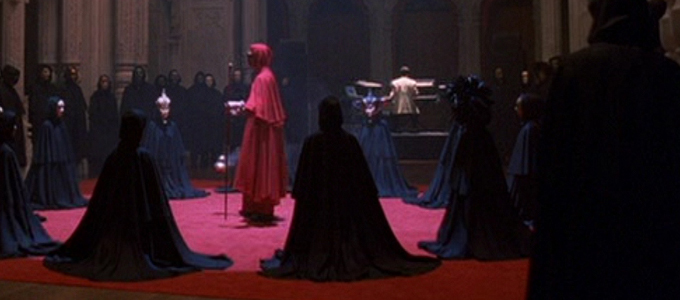
Bill passes through another door and is directed past red drapes into a cathedral type room, individuals in black cloaks, hoods and masks lining the walls on the first floor and the balcony. A man in a red hood and cape stands in a circle of individuals in black capes and masks. He is the Hierophant.

(Now my son comes in from the other room and I pause the film, not wanting him to see it, to which I’ve been listening through headphones, and he tells me about a movie he’s planning which has characters in black cloaks with blue moons on them, and they are standing around singing an operatic like chorus.)
Nick Nightingale is seen beyond, in a white tux, playing electronic keyboards, his back to the proceedings. Previous to this he has been playing acoustic pianos, but now with his playing electronic I think again of the story of the Emperor who preferred the mechanical nightingale to the real, eschewing the real which flew back to its forest, but returned when the emperor fell ill, and healed him.

Electricity also refers to the powers of attraction, the word, I read, originally meaning “amber” in the Greek, amber noted for its powers of attraction.
The man in red waves a censure around the individuals in the circle. They stand and drop their cloaks, all of them statuesque women with the bodies of exceptional models, and all looking very much the same. He continues his chant. The women pass from one to another a stylized kiss. Up on a balcony, zoom in on a man in a tricorner hat and woman turning to look down on Bill, the man nodding at him. Bill nods solemnly in return. We already have the feeling that this man in the tricorner hat is Victor.

One by one the women rise and leave the circle, under the direction of the Hierophant. They approach individuals on the periphery to kiss them, mask to mask, and lead them out of the room. The 6th of the 12 women, released from the circle with the striking of the staff upon the floor, directly approaches Bill and shares the kiss through the mask. She wears a black feathered headdress and, like Bill, her mask is gold around the eyes, and white elsewhere in simulating a mask over a real face, so in a sense it is a double mask. She leads him out of the room, down the red carpeted hallway. “I’m not sure what you think you’re doing but you don’t belong here,” she says. He tells her she’s mistaken him for someone else. She says for him not to be foolish, to leave. He asks who she is. She says it doesn’t matter but he’s in great danger and must get away while he still has a chance. A man approaches from the side to take her by the arm and asks Bill to excuse them. This isn’t exceptional. Nick Nightingale had been led away in just this manner at the earlier party, as had Bill been led away from the two women who promised to take him where the rainbow ends, led up the stairs where had been the overdosed model. There have been a number of such interruptions.
The exchange is highly artificial, stagey, the woman zeroing in immediately on Bill and urgently admonishing him to leave.
She is led up stairs to a second floor, glancing back.
All the models, near otherworldly in their perfection, wear black chokers. Marion had also been wearing a choker, as had Domino, her purple dress forming a choker around her throat.
Joceyln Pook’s “Migrations” music has begun.
Bill’s expression, of course, is inscrutable under the mask. The camera pulls in on a room in which models are involved in sexual activities before other models and guests. Pass into a dining room where we have the same on a table. Bill advances through one room after another, similar scenes of this very mechanical orgy in each.
Then Bill is in the library, walls lined with books in well bred wooden cases, watching the orgy ongoing there. The man in the tricorner hat, who’d nodded at Bill from the balcony, enters with a red-haired model. He nods to Bill. As he exits, the woman advances to stand beside Bill. “Have you been enjoying yourself?” she asks. He says he’s had an interesting look around. She asks if he wants to go somewhere more private. He is saying that might be a good idea when the woman in the black feathered headdress interrupts and takes him out with her, promising to bring him back. She tells him that he must get out, that he can’t fool them for much longer.
“Why are you telling me this?
“It doesn’t matter.”
“Who are you?”
“You don’t want to know.”
Rather ridiculously, he asks her to come with him as if taking up the role of some sort of savior figure, and and she says it’s impossible, that it could cost her her life and possibly his. He asks to see her face and reaches for her mask. She protests, tells him to go, and hurries away from him.
A servant asks Bill if he’s the man with the taxi waiting and says that the driver is at the door and urgently wants a word with him.
Cut to a room of people dancing to “Strangers in the Night”, and Nick Nightingale being led through in a blindfold.
Cut to Bill being led through a hall past numerous attendants. He’s returned to the cathedral area. The masked individuals stand around in a partial circle staring at him. He passes into it (the first person on the right is in a sun mask) and the circle closes around him. In the circle sits the Hierophant on his throne with attendants on either side. He asks Bill to come forward.


The individual in the full face mask to the right of Bill vaguely resembles him.
The music now playing is Gyorgy Sandor Ligeti’s “Musica Ricercata #2″, performed by Dominic Harlan. A Hungarian who moved to Austria, the 10th piece of Musica Ricercata was banned in Hungary as it was considered decadent. Perhaps it is coincidence that in this scene, involving masks (dominos), we have the music sung by a Dominic, the name coming from the same. And that it was composed by a Hungarian whose middle name is Sandor, and in the party scene with Alice and the Hungarian, the Hungarian’s name was Sandor.
Kubrick also used Ligeti’s music in other films of his.
Nick Nightingale plays the music of Sandor the Hungarian who had enticed Alice with Ovid’s arts of love (seduction) and his offer to introduce her to others in the art game, had asked if she would like to see the Renaissance (rebirth, renewal) statues on the second floor.
We have cycled back around to the first party in which Bill professed to know no one, he only being invited to the affairs because he made house calls. He has, however, not been invited to this level of the party…
Or was he invited? He has the password and the two models said they were leading him to the end of the rainbow.
“May I have the password please?” the Hierophant asks.
Bill had been told that the driver was waiting for him, wanting a word.
“Fidelio,” Bill says.
“That’s right. That is the password for admittance. But may I ask what is the password for the house.”
“The password for the house…”

The man in the blue mask to one side of Bill, the man in the mask that resembles Bill’s face on the other side. The man in the blue mask is only viewed in certain shots.
Bill says he’s forgotten it and a murmur passes through the room. He’s told it doesn’t matter if he has forgotten it or if he never knew it. He’s told to remove his mask and does so.
When Bill got the phone call that Nathanson had died, his remark to Alice had been he would have to go over there and show his face. Now he has.
Bill is clearly shaken.
He’s told, “Now, get undressed.”
“Get undressed?”
“Remove your clothes.”
Bill is ordered several times to do so and is told they’ll do it if he does not.
The woman in the black feathered headdress appears on the second floor and demands that Bill be let go, that they should take her, she is ready to redeem him. It reminds of Bill telling the model in Victor’s second floor bathroom that she was going to need rehab. Also, of course, is a savior scene, the woman becoming a Christ figure with her offer to exchange her life for his, or as much is implied.
“Are you sure you understand what you’re taking upon yourself?” the Hierophant asks.
She says she does and Bill is told he is free, but is warned not to make any further inquiries or to tell anyone what he has seen, or there will be dire consequences for him and his family. “Do you understand?”
When Bill had told Mandy she needed rehab, he had emphasized with a “Do you understand?”
Beethoven’s Fidelio happens to be about a woman who masks herself as a man, a Fidelio, thereby gaining access to a prison in which her husband is being held, and freeing him.

Bill nods his head that he does understand and turns to watch a man in a bird beak costume lead the woman away. He asks what will happen to her. “No one can change her fate now. When a promise has been made here, there is no turning back,” he’s told. “Go.”
Next we see him entering his home (5A on the door), carrying the bag in which is his costume. We see through the door that the blue hall outside is decorated with fleur de lis.
He steps through Helena’s door to look at her sleeping. He goes to the living room where the Christmas tree is still lit. Into his office where he unlocks a cabinet and conceals the Rainbow bag in it.
Undressing, he enters his bedroom. Alice, asleep, is smiling, laughing. He shakes her and she wakes in a panic. He apologizes to her for waking her, saying he thought she was having a nightmare. She says she was having a horrible dream. (It is a riveting piece of acting and Nicole Kidman addresses it in a film on Kubrick, saying that she wasn’t sure what he wanted and did the scene several times with his coaching until he got what he was looking for.)

The same blue as the blue mask.
It’s a little after four. “It took longer than I thought,” Bill says. She pulls him to lie down beside her. He asks what she was dreaming and she says weird things, “So, weird.” He wants her to tell him.
She says they were in a deserted city and their clothes were gone, they were naked, and she was terrified. She beings to cry, saying she felt ashamed, and angry. He rushed away to go find clothes and she felt wonderful. Then she was lying in a beautiful garden and a man walked out of the woods, the man from the hotel, the Naval officer. He stared at her and he laughed. “He just laughed at me.” Alice lies back down and sobs.
“That’s not the end, is it?” Bill says. “Why don’t you tell me the rest of it.”
Alice says no, it’s too awful.
“But it’s only a dream.”
Alice sits up and holds Bill as she tells him they made love, that there were then hundreds of people fucking around them. And that she was then fucking other men. She didn’t know how many she was with, and she knew he could see her. And she wanted to make fun of him, to laugh in his face. And so she laughed.
Fade out.
The movie cut much of the dream that was presented in the original screenplay.
I think it started in my parents house. They weren’t there. I was alone. That surprised me because our wedding was the next day and I didn’t have a wedding dress. Then you and I were floating above a ancient city. It was a kind of crazy mix of ancient architectural styles. Oriental, Egyptian, Greek and Roman architecture. And it was completely deserted. The streets were empty–no people, no animals. And I remember thinking, so this is our honeymoon. Then it was night and the sky was so full of stars, and so blue and wide it seemed like it was painted. You said it was the ceiling of our bridal chamber and you took me in your arms and made love to me and said you would love me forever…We made love and it was wonderful, though there was a sadness to it, and a presentment of sorrow. Suddenly it was morning and we were somewhere in the strange city. We were still completely alone. But something terrible had happened–our clothes were gone. I was terrified as I had never been before, and felt such a burning shame that it almost consumed me. At the same time I was furious with you because I thought it was your fault. And this sensation of terror, shame and fury was more intense than any emotion I had ever felt before. You felt guilty and rushed away naked, to go and get clothes for us.
As soon as you were gone I felt wonderful. I neither felt sorry for you, or worried about you. It was heavenly to be alone. I was lying in a lush garden, stretched out naked in the sunlight, and I was far more beautiful than I ever was in reality. And while I lay there, a young man walked out of the woods. He was the young Naval officer I told you about from the hotel. He looked different but I knew it was him. He stopped in front of me and looked at me searchingly. I laughed seductively and wantonly, as I have never laughed in my life, and he held out his arms to me and sank down beside me…
He looked at me…and slowly took me in his arms…and we began making love. I seemed to live through countless days and nights–there was neither time nor space. And the more we made love the more our hunger for each other increased. And just as that earlier feeling of terror and shame went beyond anything I had ever felt, so nothing can be compared with the freedom and happiness and the…desire that I now felt. Then I realized there were other couples around us–hundreds of them, and they too were making love. Then I was making love to the other men, and as soon as my longing was satisfied with one, I wanted another. I can’t say how many I was with. And yet I didn’t for one moment forget you. And all this time, you were buying the most beautiful clothes and jewelery you could find for me.
Then you were being followed by a crowd of people who were shouting threats. Then you were seized by soldiers, and there were also priests among them. Somebody, a gigantic person, tied your hands. You were still naked. I knew you were going to be crucified but I felt no sympathy for you. I still blamed you for everything that had happened. I felt that I was far removed from you but I knew you could see me naked in the arms of countless men in this sea of nakedness which foamed around me. The soldiers began to whip you and blood flowed down you in streams. I saw it without feeling any surprise or pity. Then you smiled at me as if to show you had fulfilled my wish and bought me everything I wanted. But I thought your actions were ridiculous and I wanted to make fun of you, to laugh in your face. They began to nail you to the cross and I hoped that you would be able to hear my laughter. And so I laughed as shrill and loud as I could. That must have been the laugh that you heard when I woke up.
It’s made obvious from this dream that the film isn’t just about a man with a narrow view of women struggling with expanding his mundane view of sexuality. Kubrick has charged the film with mystic subcontext which, being a film director, he chose to have not told via Alice’s dream, as in the screenplay, but with images in the film itself.
Now to throw around some thoughts which may not speak to the film directly but I’ve wondered if they had some play in the story that the screenplay’s dream couched in symbolism most familiar to Western viewers through stories of an Eden-type garden and savior crucifixion imagery.
We are perhaps close here to a version of the mystic marriage, of the Shekinah cleaved from the King, the godhead (of which she is a part), to reside in exile in the base world, the mother of all, and the task being the reunification of her with the En Sof.
The desire is to unity.
When a man sins it is as though he strips the Shekinah of her vestments, and that is why he is punished; and when he carries out the precepts of the law, it is as though he clothes the Shekinah in her vestments.
There are hints of the Garden of Eden in the dream and if you look at the story of Noah closely it is very much another creation myth, in that it is the ushering in of a new world, just as in the story of the Greek flood, Deucalion and Pyrrha surviving and repopulating the world by throwing stones behind them (the bones of their mother) as they went.
Wouldn’t hurt to examine the screenplay’s dream in respect to any links to the Garden of Eden, with its emphasis on Alice waking, feeling a terrifying shame, and Bill running off to get clothes for her, though the dream begins with their floating ancient cities in which they saw no flesh, reminding perhaps of the ark floating on the waters (the idea of bitterness contained in the waters by definition of the word) and Alice feeling great sorrow, though she also felt wonderful.
Adam and Eve, separated from the godhead, living with Shekinah in the material world, received garments of animal skin, or the physical body.
ORV is to be naked, the type of nakedness experienced in the Garden of Eden, Adam and Eve not being ashamed until they ate the fruit of knowledge.
That which is given as the snake (whose name means also learning by experience, prognostication) was the most cunning (HIH ORVM) of all life. So he tells the woman if she eats that are eyes will be opened (PhQCh) and she will know good and evil. PhQCh is to be observant.
So Adam and Eve ate and their eyes were opened, the word for eyes meaning also fountains, and they knew they were naked.
Whereas ORV is the word for naked, OVR is the word for skin. Another form of OVR means to blind, as in having a film over the eyes. The eyelids.
Bill goes running off to find clothes for Alice, all that he does seeming as an effort finally to win her back, even to the point of self sacrifice, a self sacrifice she appears to demand. In the meanwhile, however, the naval officer had appeared and their eyes meet, he looks searchingly at her, this point is made, and Alice is filled with a great desire and making love with him enters a sense of eternity, timelessness. As they made love suddenly there appeared more and more people making love.
In the story of Noah, for the dove that flew out of the ark is IVNH, a word that carries in it the idea of warmth, as from their mating, and is from IIN, which is the fermentation of wine and is also intoxication. Then the injunction comes after that the earth should be replenished.
We move into the curious scene of Bill’s self sacrifice and bloodshed, establishing him as a Christ figure in Alice’s dream.
A further injunction given Noah concerned blood:
But flesh with the life thereof, which is the blood thereof, shall ye not eat. And surely your blood of your lives will I require; at the hand of every beast will I require it, and at the hand of man; at the hand of every man’s brother will I require the life of man. Whoso sheddeth man’s blood, by man shall his blood be shed: for in the image of God made he man.
This separation of Shekinah, the bride from the bridegroom (the bride groom operating here in the dream as Bill attempting to win back Alice) is observed in the movie through a later reference to the name YHVH. The Shekinah is written of as being the final H (heh) in the name YHVH. Take away that final Heh and one has IHV, a permutation of which is HIV, which the prostitute, Domino, is given as having.
To complicate matters, there is a Dark Shekinah who is sometimes linked to Lilith.
Alice and Bill’s apartment is thus filled with references to the garden and the fruits plucked from the tree, those fruits representing also the separation of the Shekinah and mankind.
Bill certainly recognizes that Alice’s dream contains elements of the party from which he’d just been ejected. “But that’s not the end,” he’d said, reminded he had been invited to where the rainbow ends. He had assured Alice it was just a dream.
Perhaps, at the party, he’d envisioned Alice in the arms of these men.
I really see no reason to view the orgy as anything but a mystic level of the party at Victor’s and of life in general. The music at Victor’s had been all about eternal love, but if the movie was only about a man’s attempting to divine the difference between sex and love on only a physical human level, there would be no reason to have this party. And if the movie was primarily about some secret level of society (and this party and Alice’s dream of it are the hub of the movie) then there’d really be no reason for this drawn out odyssey-like exploration of the confusion of love and sex and Alice’s dream replaying the party on an unconscious level, an Alice through the Looking Glass, down the Rabbit Hole adventure exploring a possible hidden reality which is here being expressed in the allegory of the masked orgy.
Bill, as presented at the beginning of the film, is a person highly unlikely to go through a fundamental crisis over his wife fantasizing an affair with a naval officer. There’s no reason for her confession to push him into the night and into the arms of a prostitute and finally to this curious party. The mystery with which he’s dealing is broader, though what is love and what is sex have their place in it. He appears to have been propelled into an initiation drama with its attending revelations that shock one out of mundane complacency into considering deeper aspects of life, but that initiation drama is no more shocking and strange than what happens when any individual finds themselves unbound by the cultural map that has informed them, since near the day of their birth, where they are, who they are and how it all fits together.
At this point, Bill believes he knows something about what has happened. He still has questions, but he has some basic assumptions that are already forming a story about what he believes has occurred. Next, the film will continue with seemingly building up a story in which he can believe based on his assumptions and experience, then breaking it down so he knows little more than when he began.
Next: Nick’s Hotel, Rainbow, Somerton
The Zeigler’s Party
Naval Officer, Marion
Domino, Sonata Jazz, Rainbow
Somerton, Alice’s Dream
Nick’s Hotel, Rainbow, Somerton
Marion, Domino, Sharky’s, the Hospital
Zeigler, Home, the Toy Store
Bill Tempted by Domino
Cut to the street and Bill walking down it, a Mexican Cafe and Dry Cleaners in the background.

A pizza shop. Cars passing. The streets are wet. He looks at a woman and man passionately kissing next to a green shop, a Santa in the window behind them and a closed rose in neon above their heads. The shop number is 280, the name of the shop is “Nipped in the Bud”.

His thoughts return to his wife in bed with the Naval officer.
The woman in the sequin dress had said she’d half of 5th Avenue in her eye when Bill helped her with a clean handkerchief. Bill is now going to get a taste of the same via all the signs in the street assuming meaning via their foreshadowing of events. We are reminded of the flood that the bible gives the flood as a cleansing of the earth.
And the Lord said, My spirit shall not always strive with man, for that he also is flesh: yet his days shall be an hundred and twenty years. There were giants in the earth in those days (the NPhL); and also after that, when the sons of God came in unto the daughters of men, and they bare children to them, the same became mighty men which were of old, men of renown. And God saw that the wickedness of man was great in the earth, and that every imagination of the thoughts of his heart was only evil continually. And it repented the Lord that he had made man on the earth, and it grieved him at his heart. And the Lord said, I will destroy man whom I have created from the face of the earth; both man, and beast, and the creeping thing, and the fowls of the air; for it repenteth me that I have made them. But Noah found grace in the eyes of the Lord.
Bill continues to walk and behind him we see a jewelry shop and on his left is a neon sign in a window that simply says “Flying”. A sign above reads “Flying Dutchman.”

Curiously, Danny in “The Shining” had worn a jacket that read “Flyer”, which is initially seen by the audience as reading “lyer”. Also, in “The Shining”, when being shown around the lodge upon her arrival, Wendy, Danny’s mother, had made mention of the frenetic activity as everyone made preparations to leave. When she was told that by 5 o’clock the place would be empty, she had replied, “like a ghost ship”. Such as the Flying Dutchman? A ship that sails the seas forever, appearing out of the mist, never finding port.
The Flying Dutchman. We remember the Van Gogh painting in the kitchen. The Van Gogh book that Alice was wrapping up, perhaps as a present for Bill.
Bill slaps one hand against the other. Passes the Pink Pussy Cat Boutique. Rounds a corner.

“Listen to this. She had a red rose in her mouth. She was doing a Mexican lap dance right in my face,” a man in a group of people advancing from the opposite corner is going on loudly.
The side of a building is painted with “Everything electronic for less! 555-1121 Thank you. I Love you!” One is reminded of Marion’s declaration of love to Bill.

The green and white striped awning decorates a building that will later be dark and in the neighborhood of Domino, then a little later will be “The Rainbow” shop, and even later will…well…have a quadruple life…as Sharkey’s.
“I’ve got scars on the back of my neck,” the man continues, then seeing Bill yells, “Hey, hey, hey, what team’s this switch hitter playing for?! Looks like the pink team. Faggot!” And slams into Bill as they pass, knocking him into a car.

Things Bill had seen, actions he had made, are being played out in this altercation. He had just passed a Mexican restaurant, a couple making out under a rose, and at the Nathanson’s the maid had been Rosa, and his own babysitter a Roz. He had pounded his own fist as he passed the Pink Pussy Cat Boutique. It’s as if that aggression, Bill pounding his own hand, is now being played out by these individuals who slam him against the car and who had spoken of a Mexican lap dance performed by a woman with a rose in her mouth.
I hesitate to belabor the riddling sphinx, having just finished writing about it in relation to “The Shining”, but the scratches on the neck reminded me not only of the strangling sphinx (who makes an overt appearance in “Clockwork Orange”, two statues of the sphinx outside the house where Alex is temporarily blinded by his buddies with a smashed milk bottle), but of Marion with Bill, her hands on the back of his neck as she made her confession. And we have here an association with the feline being raised via the Pink Pussycat. But the sphinx is all to do with enigmas, isn’t it, a polymorphic creature presenting the face of a human.
“Merry Christmas, Mary!” they yell (a variation of Marion, Mary meaning bitter waters) and continue to taunt him as they walk off saying they make dumps bigger than him. “Prime cut of meat! You want to take a ride on this?” Slapping their asses. “C’mon macho man! You wanna piece of this? Exit only, honey!” They yell to him to go back to San Francisco where he belongs.

Two are wearing what look like college jerseys under their jackets but the only letters evident are AL.
Stunned, Bill continues walking down the street.
Shot from above of a another corner.

Then down on street level with Bill again as he passes a man getting off a pay phone who says, “Oh, I see, I’m taking care of it baby” and glances at Bill as he passes. As Bill approaches the corner a seeming prostitute in gray fur hat and black and white stripe fur jacket takes notice of him. She wears a short purple dress, knee high black boots and lace stockings. He is stalled at the corner by traffic and she approaches, asking him what time it is. Ten past twelve he answers, and we see behind them a hardware store, the word PAINTS in different colors. But then different neon sign colors have been ablaze everywhere.

This hardware store will later be revealed as having painted on it the words Manning and Bowman. Just a couple of doors down from it a store that will later be revealed to be the Rainbow costume shop, but for now it’s dark, none of its lights lit. It is the same building that had been decorated with the green and white awning in the previous scene. So, here we have Bill walking past a double of that street and having a second eventful encounter.
The woman (we don’t find out her name until later) asks if he’s going anywhere special? No, just taking a walk. She follows along and they pass the Original Josef Kreiber Knishery, building 269, then a shop with a Lotto sign in the window. She asks him, next to a green neon hotel sign, if he’d like a little fun, if he’d like to come inside with her. “It’s a lot nicer in there than it is out here,” she says, pointing to double red doors up a short flight of stairs.
Nervous, in a curiously choking voice Bill points at the doors. She lives in there? By herself?
No, with a roommate. She tells him she’s gone though and it’ll be all right, no one will bother them.

They enter building 265, the audience perhaps thinking that after being called faggot, maybe the shocked Bill is resolved to prove he’s not, or perhaps he’s taking up with the prostitute in response to his wife’s confession.
Also, directly after Bill having been pushed into the car by the men who accused him as being a “switch hitter”, a faggot, he has met this supposed prostitute who is inviting him into her apartment next to a building in the windows of which Lotto was advertised. One could be reminded of Lot of Sodom and Gomorrah. LT, though meaning bitumen, with different vowel points means covered, private, secret, incantation, and appears to be related to a word meaning to cover or veil. The sin of Sodom is considered by some to be gross inhospitality and greed, so it’s interesting that Bill is eventually going to insist on giving the woman money for nothing. Her invitation to go inside for fun, it being nicer inside than out, will also later be echoed at the orgy where a woman in a mask peculiarly edged with black striping on white (Domino wears the black and white striped coat) approaches Bill and asks him if he would like to go somewhere more “private”.
Bill follows the woman into a hallway of beige tile and green paint. A blue stroller rests next to her door, which reminds of the painting of the pregnant woman. Not to mention it’s Christmas when the birth of the solar deity is celebrated.

They enter the woman’s apartment where is, just inside the door, the ubiquitous Christmas tree. Bill remarks on it, saying it’s nice.

The tree in Domino’s apartment
The woman leads him into the kitchen, apologizing for the mess, “Maid’s day off,” moving a dirty pan, and as he stands in the doorway Bill’s expression is one of barely concealed horror of the small, dirty apartment. A tub is in the room filled with presents with an odd, single gold shoe resting on one of them. Red and white bras hang from a bar above. Dirty dishes and an open peanut butter jar sit on a table. Christmas cards hang on the walls.

She begins removing her hat and coat, revealing under her coat a purple dress cut so it has a choker piece for a neck attached to it. “Cozy, cozy place,” he says, sitting on the edge of the tub.
In “The Shining”, Jack Torrance shown the rundown suite in the huge lodge that he and his family would be staying in, had remarked, “Cozy.”
I had brought up the sphinx earlier, her strangled her victims, whose name was believed to come from the word “sphincter”. Curiously, from the beginning of this evening’s events, all the women (exempting Alice) will wear chokers. Marion wore a choker, Domino wears one, all the women at the “orgy” will wear chokers.
The conversation Bill has with the woman is presumed to be a transaction between a prostitute and client, but it’s actually pretty ambiguous.
“Do you suppose we should talk about money?” he asks.
She says, “Yeah, I guess so. It depends on what you want to do.”
I mean, they could have just a conversation about money. After all, it’s a big subject here. Money clearly both divides and unites their two worlds.
“What do you want to do?” she asks.
“What do you recommend?”
She laughs about this, disbelieving. “What do you recommend? Uhm, well, I’d rather not put it into words,” she says removing her gloves.
“I’m in your hands.”
“Okay,” she laughs. “How does one hundred and fifty sound?”
“Sounds wonderful.”
She says, “Don’t worry. I don’t keep track of the time.”
Cut to Alice at home, sitting at her breakfast table, eating chocolate snack cakes, drinking milk, smoking, watching television. On the screen we first see pigeons then a waiter in white jacket and black tie serving a table, the customer saying “Thank you”, the waiter replying “Prego, prego,” the man replying, “Grazie.” the waiter replying, “You’re welcome sir,” a voice over saying, “If I was Italian he would have answered me in Italian.”

The white coat and black tie remind me of Nick Nightingale. The transaction reminds of Bill who is in the meanwhile being serviced (well, not quite) by the supposed prostitute. The film being watched is “Blume in Love” about an impotent divorce lawyer, who finding himself divorced from his wife, and still being in love with her, ventures to win her back.
The scene played here from the movie concerns language, communication, the man, who is American, being waited on by a man who is Italian. The man addresses the waiter in English. The waiter replies in Italian, but when the American responds in Italian the Italian responds in English, reluctant to converse in Italian with a non-native speaker.
I’m reminded of the language of the signs Bill passes, certain subsequent events which happen playing out those signs. If Bill notices, in some respects it is a conversation, but one sided, it right now seems it’s a conversation in which Bill is powerless to take part. Such as the men on the street who talk about the woman with the rose in her lips, who call Bill pink and slam him into the car. What was he to say in response, if he recognized in their actions the preceding signs?
So did the emperor carry on a secret conversation with the nightingale. “I only ask one thing,” the nightingale said to the emperor at the story’s end; “let no one know that you have a little bird who tells you everything. It will be best to conceal it.” Which was an odd request as in the Anderson story the bird simply sang to the emperor, its songs dispelling the faces of death looming and returned him to health.
Dissolve to Bill facing the prostitute. Tinkly piano music reminds, again, of Nick the pianist. They kiss. He looks at her as if he’s not sure what to do. “Shall we?” she asks.

Domino and Bill or Dave Bowman and Frank Poole

Well, no wonder the woman was reluctant to put it “into words,” her profile reminds distinctly of Dave Bowman conversing with Dr. Frank Poole in the pod as HAL looks on, reading their lips in “2001″.
And lo and behold Bill’s cell phone rings. The camera pulls back to show him sitting on the bed. He rises, turns down the music, gestures for the woman to be quiet (his finger to his lips), answers the phone.

It’s Alice. He asks if everything’s all right and she says yes, she was just wondering if he was going to be much longer. He says it’s difficult to talk right now (he had choked and stuttered as he stood with Domino in front of her building, Domino had said she would prefer not to put it into words) but it could be a while, he doesn’t know how long, they’re still waiting for some relatives to arrive. Back at the Harford apartment, on the television screen a woman in a yellow coat and white boots walks off into the night with George Segal. Alice says she’s going to bed.
“Introducing Sociology”, the study of human behavior, is one of the books on the prostitute’s dresser. The other book, viewed directly under a mirror, is “Shadows on the Mirror”. Pastel colored Christmas lights drape the walls around her windows.

Bill hangs up. Cut to the prostitute reclining on her bed which is covered with what may be a Tree of Life spread, a stuffed tiger in the background (we will see a number of stuffed tigers in the final scene of the movie at the toy store, Bill discussing the possible meaning of the events with Alice before them). “Was that Mrs. Dr. Bill?” she asks. He nods his head yes. “Do you have to go?” He says he thinks he does. “Are you sure?” “Yes, I’m afraid so.” We notice that there are tribal masks all over the walls. There had been one at the Nathanson apartment. Now there are at least five, three beside the bed and two on another wall. Bill offers to pay the woman anyway and pulls out $150 (which will later turn out to be the cost of his costume). She says he doesn’t have to bother. But he says he wants to. He takes her hand and folds the money into it.
It should be pointed out that Domino means mask, coming from the Latin (let us praise) the lord. Domination, of course, derives from the Latin.
Before going further I’d like to note that Brian De Palma’s film, “Hi, Mom!” has a kitchen/bedroom set-up pretty much exactly like this one, which is one thing, but what’s interesting is his use in the film of a “red eye” effect that reminds of “2001″. I give images here showing the similarities. In De Palma’s movie, he sets up a camera in the window of the apartment, rigged with a red light (which recalls HAL’s red light in “2001″), by which he intends to film an encounter with a woman in an opposite apartment.
The Sonata Cafe and Rainbow Fashions
Back out on the street. Bill passes by Mancini’s cheese shop (I read that the name Mancini’s origin is from a word meaning “left handed”). Another man on a pay phone, this one in a red jacket. A couple passes and their voices are raised in the mix but I can’t tell what they say. Then James Tobias Lomas Inc. Rentals (real estate). An eatery named Gillespie’s. And sees the Sonata Cafe, a 3 above its door.
Sonata comes from a word meaning “singing”, which could have some correspondence to the name, Nick Nightingale.
A sign is above the Sonata cafe of a neon guitar with its neck pointed to the right. Now there walks into the scene a man from the left carrying a guitar case which doubles the sign, and he continues on. When Bill later returns to the Sonata, again an individual will pass carrying a guitar.
So again we pointedly have the doubling, a sign then being physically represented.

The Sonata Cafe
Hearing piano, Bill stops to look at Nick Nightingale’s picture on the marquee, the doorman eying him. He enters the club, goes down a red painted stairway lined with mirrors. A sign reads “Please present receipt when exiting” and another reads “All Exits Are Final.” I’m reminded of the men on the street shouting exit only.
He coughs. Is greeted by the maitre’ d who asks he’d like a seat at the bar (a football game plays on the tv above, perhaps the same game that had been playing when he was with Alice earlier in the evening) or at a table. He requests a table. The nightclub is nearly empty. He takes a seat at one of the tables, all of which are illuminated with a globe light in the middle, reminding of a crystal ball in which fortunes are told.

The band is shutting down for the night, Nick introducing its members, “On the bass, Mr. Larry McVay, on the drums, Kip Fleming, and on the guitar the one, the only Mr. Bobby Berman.” Nick leaves the stage and is called over by Bill. Nick says the band sucked anyway that night, asks what brings Bill out? A patient in the neighborhood. Oh, does Bill live in The Village? No, they have an apartment on Central Park West.
“You married?”
“Nine years” With a seven year old daughter.
Nick says he has a wife and four boys in Seattle.
“You’re a long way from home.”
“Yeah, well, you’ve got to go where the work is.”
Bill asks if this is Nick’s band and he says it’s a pick-up band, reminding that Bill had just been picked up. Bill asks who he normally plays with and he says anybody, anywhere, divulging he has another job that night that starts around two. And believe it or not he actually doesn’t know where it is. The party’s in a different place every time and he only gets the address about an hour before.
“What’s the big mystery?”
Indeed.
“Hey, man. I just play the piano.”
“Is there something I’m missing here?”
The two women at the Zeigler party had stated that there were things Bill was missing.
“I play blindfolded…And the last time, the blindfold wasn’t on so well. Oh, man, Bill, I have seen one or two things in my life but never anything like this, and never such women!”
No, certainly, ever such women.
Bill laughs. Nick’s phone rings. “Yes, sir,” he snaps to attention. “I know where that is.” He writes a word on a napkin and Bill holds the napkin for him, stabilizing it on the table. Bill asks what it is. “The name of a Beethoven opera, isn’t it?” Nick replies.
FIDELIO.
I have already commented above on the word fidelio and its relationship to the (rain)bow of the covenant. The screenplay actually gives the password as “fidelio rainbow” making itself the link between rainbow and fidelio.
Nick confesses it’s the password and says he has to leave. But Bill presses and says he knows there’s no way on earth he’s going to leave without taking Bill with him. Bill asks for the address, says he’ll go there by himself and there won’t be any connection between them whatsoever (recollect the nightingale’s request to the emperor that he not divulge to anyone that the nightingale tells him everything). Nick says Bill couldn’t get in anyway because the people are costumed and masked and where’s he going to get a costume?
Cut to the street. “Sewing Thread” is painted on a building.

The taxi pulls up before a costume shop, a neon rainbow sign hanging above the door and under it painted the words “Under the Rainbow”. Above is a window displaying men in tuxes. The number on the awning is simply 10.


Bill goes up the stairs next to the shop and rings the bell.
“Peter, this is Bill Harford!” Bill says to a man with a foreign accent who answers on the intercom. He realizes it’s not Peter he’s talking to and says he’s looking for Peter Grenning, the owner of Rainbow Fashions. He says he’s Peter Grenning’s doctor.
As already mentioned, Bill uses his credentials as a doctor as his own password everywhere he goes, and here’s where we begin to become aware of it, after the introduction of the password “fidelio”. We see in the window of the door the reflection of the street behind and it is the Sonata cafe’s neon sax and the Gillespie Diner sign. Though he had ridden up in a cab, turning right onto this street, it seems Bill has only crossed the road, which will not be an error, an oversight. Bill apparently must arrive there by cab, at this point, just as he will arrive at the mansion later in a cab, which is one of the things that ends in distinguishing him from the other party goers.
We had seen this building just beyond the hardware store when Domino had approached Bill, but it had been dark then. In another shot of Bill and Domino, we’d also seen the opposite side of the street, and there was no Gillespie’s, no Sonata. We had also seen this building, though at that point with a green and white stripe awning, in the encounter with the frat boys who slammed Bill against a car. Kubrick isn’t simply reusing the set. He has left obvious clues. The most obvious one is that we’re able to see here the reflection of the Sonata Cafe and the Diner in the window. Also, Kubrick has left in all these versions of the street the fenced in area to the right of the building next to that one which holds the Rainbow and later Sharkey’s (in which there will also be a bow). He makes no attempt to disguise it.
Again, QShTh being the bow of the covenant, QShT or QShVT means fidelity, truth. Bill has crossed the street from the Sonata Cafe, from where he’s just received the password, fidelity, and told he needs a costume. He’s arrived by cab though it’s only across the street, the Sonata Cafe clearly reflected in the windows of the entrance to the Rainbow.

The bearded man who comes to the door is coughing, and when Bill had entered the Sonata Cafe, just across the street, he had coughed, so we are having a sort of mirroring here just as we had a mirroring of the Nathanson apartment with the apartment of Domino. The bearded man reminds of the Hungarian because of his accent and his age, but his appearance is not at all slick. He says Grenning moved to Chicago a year before hand. The man introduces himself as Mr. Milich and yes he is the present owner of Rainbow Fashions.

Bill at the Rainbow
Bill pulls out his medical board card to prove who he is and says he must have a costume, offering to pay $100 over the rental price for the inconvenience. No? $200? Ok.
MLCh means sailor, coming from a word meaning salt, as to pulverize, rub away, disappear as dust.
Bill is let into the shop by the coughing owner who admits him through a security cage, saying that one can’t be too careful these days. We notice that the arrangement of the mannequins has changed from the exterior view of the shop. The positions of the mannequin in a white coat and the mannequin with the top hat have been switched.

Entering the Rainbow

The next time Bill is in the shop, where these shirts are will instead be shoes, and a second counter will be also located here instead of just the one before the wall case of suits.
The shop owner asks him if it’s a special costume he’s looking for. Bill replies he wants a tux and a cloak with a hood and a mask. The owner directs him through a door into a room at the rear of the store, its windows filled with black tuxes.

White lights hang on the wall much like at the Zeigler party on the wall behind the stairs. Mannequins in costumes surround. “Look like alive, huh?” the man says, though they don’t, especially. Bill says, yes. The shopkeeper asks if he’s sure he wouldn’t like something more colorful? Clowns, officers, pirates? No, just the tux, the black cloak with hood and a mask, Bill says, eschewing the suggestion he go for something more rainbow colorful.

The light curtain at Rainbow reminiscent of the light curtain at the Ziegler party.
“You are medicine doctor, yes?” We expect the owner to ask about his cough. Instead he says he’s suddenly lost a lot of hair in the past two weeks, it’s falling out too fast, and leans over to point out a bald spot on the back of his head. Bill, uncomfortable and eager to be elsewhere, not too keen on the idea of giving out free advice, says it’s not his specialty, that he needs to see a tricologist and presses for the costume.
The bald spot reminds of the type of tonsure belonging to the monks in the Hierophant card of the Tarot, who are presented before the Hierophant on his throne, who wears red. The Hierophant will be soon appearing in the film.

As the shopkeeper looks for a cloak for him there’s a sound. “Did you hear something?” he asks and goes to the door to another room separated from them by windows, over which hangs the sign “Rainbow”, “Tuxedos”, “Fancy Dress”, sees Chinese dinner boxes spread over a coffee table in front of a purple sofa, enters the room and turns on the lights. He picks up a piece of lingerie off the sofa, hears a sneeze, parts the costumes on a rack behind him to reveal a Japanese man in red thong and whiteish make-up, snatches off his long black wig revealing gray hair underneath. “What on earth is going on here?!”
“Milich, I can explain everything!”
He looks behind the sofa, a young blond girl in bra and panties standing, and another oriental man in a blond wig which Millitch snatches off and hits him with a pillow. “I promise I’ll kill you,” he yells at the girl. Yells at the men, “Have you no sense of decency?”
“Milich, have you gone crazy? We were invited here by the young lady!”
Milich says it is his daughter. “Can’t you see she’s a child? You’ll have to explain to the police!” He calls her a whore and she races from the room as he grabs for her. She takes refuge behind Bill and looks at him seductively, her face made up to have a porcelain doll like transparency. She grins as the men continue about how this is preposterous as she invited them there. “Can’t you see she is deranged,” the shopkeeper says, locking them in the room, promising to bring the police. He apologizes to Bill and asks if he wanted “Blick”. “Black,” Bill corrects, the shop owner yelling at them to be quiet for the moment, can’t they see that he’s “trying to sell my customer!” As he goes back to the rack on which are the cloaks he calls his daughter a whore again, yells at her to go to bed at once, that he’ll deal with her as soon as he’s done with Bill. The girl whispers something in Bill’s ear and then slowly, invitingly, backs off.

The astonishment that the Japanese men exhibit at Milich’s response to them, it seems as though they really are surprised. The feeling is of Milich putting on a show for Bill, behaving this way because of Bill’s presence.
I have the feeling that the pair of Japanese men has an association with the twin Chinese dragons in Victor’s bathroom, and the twin Chinese jade sculptures at the Nathanson apartment. “But one of those statues ended up missing,” I think. Then realize that one of the Japanese men was hiding behind the clothing and brought out first, while the other was hiding with the girl behind the sofa. It just seems to me there must be a connection.
As with certain windows in “The Shining” which couldn’t possibly exist, one realizes that the windows facing the street on this very rear room at the costume shop shouldn’t exist. The layout of the shop is such that this room should have no opportunity at all for windows in this wall as it would be shared with the neighboring building.
Next: Somerton, Alice’s Dream
The Zeigler’s Party
Naval Officer, Marion
Domino, Sonata Jazz, Rainbow
Somerton, Alice’s Dream
Nick’s Hotel, Rainbow, Somerton
Marion, Domino, Sharky’s, the Hospital
Zeigler, Home, the Toy Store
The Naval Officer
Cut to black. The waltz again. Then an elevator door opening and Bill, in his suit, exiting it and entering his office. An employee greets him not by his name but by “Doctor” and hands him a note from behind a long, elegantly styled, and highly polished wood counter. Christmas cards hang on the wall. A small Christmas tree rests next to the counter. He asks for Jenelle to bring him his coffee, greets a nurse, Sarah, who also addresses him as simply “Doctor”.
That’s some distance there when your employees only refer to you as “doctor”.
Cut to Alice with their daughter in the kitchen, at the breakfast table over which hangs a painting of yellow apples blushed with rose. Curiously, a small picture of Vincent Van Gogh sun flowers is overlaid on part of the painting, above the apples (can’t imagine it’s part of it), and some of Helena’s drawings are on the wall beside. The daughter eats cereal, watching Bugs Bunny on the television. “Twas the Night before Christmas…” Alice, in a blue bathrobe, drinks coffee, reading the newspaper.

Cut to Bill with a model-beautiful woman, examining her, a nurse at their side. A nurse assists her when he says she can put her gown back on. The woman’s physical perfection, like the woman in Victor’s bathroom, is such that it seems almost impossible.
Cut to Alice in her daughter’s room, helping her dress, doing her hair.
Cut to Bill examining a little boy, his mother standing to the rear. He asks the boy if he’s looking forward to Christmas. The boy doesn’t mention that his throat hurts when Bill touches certain glands, but he can apparently tell, asks the boy if it hurts, and the boy says yes. Nonverbal communication.

Cut to a rear shot of Alice naked in her bedroom. The camera slides up to show her fitting on a black bra before the blinds which are wide open.
Cut to Bill examining a man’s leg. The man wears a shirt, tie and boxers. A nurse is also in the room. As he lifts the man’s leg he notes the man tensing at a certain point in discomfort and asks him “Right there?” Yes. But Bill had already discovered the source of pain through nonverbal communication.
Cut to Alice now wearing a bra that seems to be dark purple rather than black, and a black skirt. She’s with with her daughter in her bathroom, putting on deodorant, sniffing her underarms.
Cut to Alice wrapping up a book on Van Gogh and her daughter wrapping up another present for a Bill. “Very good choice” she says to her.
Cut to Bill and Alice sitting on their daughter’s bed listening to her read.
Cut to Alice passing through the dining room, its long table stacked with gifts and books and wrapping papers. As she enters the living room she remarks to Bill that they should call the Zeiglers and thank them for the party and yawns. Bill, sitting on a sofa watching a football game, says he’s taken care of it.

She asks him how he feels about wrapping the rest of the presents and he replies how about tomorrow. We see yet more paintings of pastoral archways and hedged garden scenes on the walls.
Now to Alice facing her bathroom mirror, blandly returning her own stare, thinking, deciding, opening the medicine cabinet. Getting out a band aid box.

Taking pot from it. (In the screenplay she is given as suggesting they break the law.) So there is a little double duty for the box, it having a dual identity just as doubles are rife throughout Kubrick’s films. The bandaid box is both a bandaid box and holds the weed.
Then Alice is in lingerie on the bed smoking a joint with Bill. She brings up the subject of the two girls Bill was with at the party. “Did you by any chance happen to fuck them?” she asks.
Bill, taken aback, says, “What are you talking about?” She says he was blatantly hitting on them and he objects that no he wasn’t. She asks who they were. He says they were just a couple of models. “And where did you disappear to with them for so long?” Bill kisses her and says he didn’t disappear with anyone, just that he was called upstairs to see Zeigler who wasn’t feeling too well, thus keeping the knowledge of the overdosed woman between Zeigler and himself. In turn, he asks who Alice was dancing with and what he wanted. She replies he was a friend of the Zeiglers. “What did he want? Sex, upstairs, then and there,” she laughs. “Is that all?” Bill asks. He says he guesses that’s understandable as she’s so beautiful. She stands and backs away from him.
“So, because I’m a beautiful woman, the only reason any man ever talks to me is because he wants to fuck me? Is that what you’re saying?”
“Well, I don’t think it’s quite that black and white. But I think we both know what men are like.”
“So, on that basis I should conclude that you wanted to fuck those two models.”
“There are exceptions.”
“What makes you an exception.”

He explains he’s an exception because he loves her and would never want to lie to her or hurt her. Combative, she argues then that he would not fuck them out of consideration for her and not because he didn’t really want to? Bill asks her to relax, telling her the pot is making her aggressive.
“No, it’s you! Why can’t you ever give me a straight fucking answer!”
Bill objects he has no idea what they’re arguing about. Alice says she’s just trying to figure out where he’s coming from. She asks him what he’s thinking about when he’s examining a woman with gorgeous tits. He explains that it’s professional and a nurse is always present, that the last thing on his mind is sex.
Assuming a childish voice, Alice asks doesn’t he wonder if one of those women might be wondering what handsome Doctor Bill’s dickie might be like.
He sighs in disgust and assures her sex is the last thing on the hypothetical patient’s mind as she’s afraid of what he might find.
“So, after you tell her that everything’s fine? What then?”
Exasperated, he tells her that women basically just don’t think like that.
She argues so men have to stick it everywhere they can but with women life’s just about security and commitment? Bill says that’s simplified but yes.
“If you men only knew.”
He says she’s stoned and trying to pick a fight and make him jealous.
But you’re not the jealous type and why not, she demands.
He replies it’s because she’s his wife, the mother of his child and he knows she’d never be unfaithful to him.
“You are very very sure of yourself, aren’t you?”
“No, I’m sure of you.”
Alice doubles over laughing and falls to the ground. “Now we get the fucking laughing fit, right?” Bill says.

She asks him if he remembers the summer before at Cape Cod? Did he remember the young naval officer in the dining room with two other naval officers? A waiter brought him a message and he left. Nothing rings a bell? She says she saw him when he was checking into the hotel, that he glanced at her, and she could hardly move. That afternoon, “Helena went to the movies with her friend and you and I made love, and we made plans about our future” but at no time was he ever out of her mind. She thought if he wanted her, even if only for one night, she was ready to give up everything. Bill, Helena, her whole future. Everything. And yet Bill was dearer to her than ever at that moment and her love for him was most tender and sad. She barely slept and woke up in a panic the next morning. Was she afraid the officer had left or might still be there? By dinner, she realized he was gone and she was relieved.
Occasional traces of music had entered under the conversation, barely distinguishable, which mute now.
Bill stares on in stunned disbelief at the confession.
The phone rings.
He sits, staring.
The phone rings.
Finally, he answers. “When did it happen? No, I have the address.” He says to Alice, “Lou Nathanson just died. I’m going to have to go over there and show my face.”
The phone is black and on the right side of the bed (as one faces the screen). In the shots of the bedroom before they went to the party, the phone was on the other side of the bed and was a white model of the same design. It is no longer observed. The black phone had not been there. The lamps too have now changed from the evening of the party and have black heavy set bases.
The pillowcases and sheets had been white the night before and now are a rose-rust pink shade.
Alice has just said she was glad the naval officer was gone and she was relieved. It’s to be wondered if a link can be made with the phone call that immediately follows, a man having died.
The street. Fire lane.
Bill sitting in the cab.

Cut to his imagining his wife on a Cape Cod bed covered with an old quilt, she writhing in the embrace of the white-suited naval officer, slipping off her panties. These periodic imaginings Bill will have, of his wife with the naval officer, stand out as they seem to belong to a different time, a different place, as if intended to recall more the time of WWII than the present.

That Alice’s confession involves a naval officer is interesting, for we’re dealing with the story of the rainbow, perhaps of the flood here, and though the ark of NCh (Noah) is no real ship, and the story is itself a matter of myth, we still have in it a ship and what must a ship have but one who operates it. Such as a naval officer who was called away. Indeed, Noah was a tiller of he vine and can be identified with Dionysus, the “new wine sailor”.
Bill Tempted by Maron Nathanson
Methuselah, that old old old man, died just prior the flood, according to the bible. His death is important to the story of the flood, the name MThVShL containing in it MTh (an adult, as of full length, from a word meaning an extent of time) and, by permutation, MVTh. With his death there is a passing of a first tier generational line extending from the story of creation to that of the flood, after which comes a sort of rebirth.
Bill disembarks an elevator into a beautiful lobby that indicates a social scale that stands somewhere between the Zeiglers and the Harfords. A maid crosses a classically styled hall in which Empire style furnishings are precisely, symmetrically arranged, no stray clutter or books or shoes under tables. She answers the door and takes his coat.

He greets her as Rosa (his babysitter had been named Roz) and she greets him as Dr. Harford. He asks how Ms. Nathanson is and she replies not so good, directing him toward the bedroom. The hallway which leads to the bedroom has in it two tables displaying two antique Chinese jade sculptures, which may recall the two Oriental dragons to either side of the fireplace in Victor’s bathroom.

Bill walking down the hall to Nathanson’s bedroom.
Bill knocks on the door and is invited into a bedroom done in something like French Provincial styling, the wall paper a fleur de lis pattern. A Christmas tree is on a dresser in the background. It all reminds very strongly of “2001″ and the room in which Dave Bowman was at the end of the film, where, as an ancient man, he died after seeing the black monolith at the foot of his bed.

Bill entering the bedroom of the dead man, Nathanson.
“Marion,” Bill says, greeting a pretty blond woman in black clothing and delicate beaded choker, who rises and thanks him for coming. He tells her he’s so sorry, that he was very brave. She glances to the bed off screen (it is now we are certain they are in the dead man’s bedroom) and appears distinctly uncomfortable as he continues his gentle bedside patter, he asking how she’s holding up. She says she’s numb, that it hasn’t sunk in, and asks him to sit down. Now the camera moves to the bed and the headboard is yes much like the one in “2001″. Bill touches the dead man’s forehead, then sits down with her. Medical equipment is all around the bed.
Kubrick is linking Nathanson with Dave Bowman of “2001″. That he’s linking with Dave Bowman demands attention and reminds again of the bow set in the cloud. The Hebrew letter Samekh is linked with Sagittarius, the bowman, both being often given as correspondences of the Tarot card, Temperance, also named Art, in which an angelic figure is depicted pouring water from one vessel to another. Its root means to lean upon, uphold, support. And Bill has just asked how Marion is holding up, plus of course he is partly there to support her though he simply put it to Alice as a need to show his face. Dave Bowman, shot like an arrow through infinity, landed in a seemingly hermetically sealed French baroque bedroom in which he spent the remainder of his life in solitude, and upon his ancient death shed his body and became a giant fetus soaring above the earth. And now here he is in “Eyes Wide Shut”, lying dead in the room where Bill Harford consoles Nathanson’s daughter, who relates his last hours.
Further establishing the link, in a later scene the name “Bowman” is seen painted on the side of a building above a hardware/paint store near “The Rainbow”.
I should perhaps mention that NCh was 600 years of age at the time of the flood. 600 is the number of Mem (the letter M, meaning water) in its final form.
“It’s so unreal,” Marion says. (Events will become even more unreal.) “Daddy had such a good day. His mind was clear. He remembered so many things.” She explains he had dinner then went for a nap, she talked to Rosa in the kitchen, then came in and at first thought he was asleep, then realized he wasn’t breathing. Bill assures her that from what she said he died peacefully. She struggles not to cry. He asks if she has called relatives and she mentions trying to call her stepmother in London and that her boyfriend Carl is making calls and will be over soon. She asks if Bill remembers meeting him and reminds Bill he’s a math professor. She divulges that they will be getting married in May. Bill congratulates her on the wonderful news.
She sounds not so sure. She says they’ll be moving out to Michigan and Bill says it’s a beautiful state, that he thinks she’ll like it a lot. “It really could be a wonderful change for you.”
Marion reaches for words. Breaks into tortured sobs. Bill leans forward. She grabs him and kisses him and he returns the kiss, though is certainly surprised as he pulls away and begins to recover his composure.
“I love you,” she says and that she doesn’t want to go away with Carl. Even if she never sees Bill again she doesn’t want to live far away from him.

I guess this is what you get for house calls. At the office, Bill’s visits with his patients are clinical, boundaries firmly set, but with his house calls the boundaries are less firm.
Marion acts as Alice might have done with her naval officer, ready to give up her new life with Carl even if it means never even seeing Bill. She is also playing out Alice’s suggestion that the women he sees in his office may fantasize about him on a personal level, only Marion is not just interested in sex, she is as eager to throw away everything just for a recognition of her love, as Alice had said she was.
Bill, resuming his friendly bedside professional manner, gently tells her she’s upset and that she doesn’t realize what she’s saying. She says she loves him. He says but they barely know each other, only having talked about her father. The doorbell rings, she says it’s Carl and asks him not to despise her as she prepares for Carl to enter.
The scene of the maid receiving Carl in the hallway is an opposing view of the hallway from when Bill entered. Carl is wearing a black coat much like Bill’s. His demeanor is much the same. He looks much the same as Bill only taller and slightly different as if a second-hand not-quite Bill. The maid calls him Thomas.

Thomas means twin.
Directed to the bedroom by the maid, the camera follows Carl down the hall to the bedroom and we notice that one of the jade sculptures is missing.

Carl, a short time later, walks down the hall to Nathanson’s bedroom.
He enters, again an opposing view of the room from when Bill entered.

There is something unreal in the way he reaches out his arms to Marion, saying too placidly but sincerely, “Darling,” but also reminding of Bill’s bedside manner, as if Carl is acting the part of Bill in a play nearly to perfection but troublingly off the mark. And perhaps he just misses because he is a math professor, a just missing the mark that has nothing to do with the profession of math but of the nature of individuals and how they’re more than a set of numbers, no matter how mathematical nature is. Marion timidly kisses him (begins to kiss him from the right and then uncertainly, nervously switches to the left) and he tells her he’s sorry and asks how she’s doing, his entry conversation very much like Bill’s. He shakes Bill’s hand and thanks him for coming.
Briefly, Marion and Bill mirror each other’s movements, crossing an arm over the stomach, other hand to face. She places a finger over her lips. Bill places a finger over his lips. These seem like unconscious gestures reflecting their nervousness, but remind also of the idea of keeping silence.
Marion looks a little like Alice Harford, actually, her hair a little blonder perhaps, pulled up (as is Alice’s usually), tendril curls draping down. And that she looks a little like Alice is brought home more by Carl looking so very much like Bill, though also missing the mark. His hair is brown and styled in a similar manner, and though he wears glasses and is taller, if they were placed side by side and said to be brothers then someone would likely say they see a resemblance. His voice and manner are as professionally reserved.
Likely, the attentive audience member is saying, “Oh, my god! Poor Carl! Marion can’t have Bill so she’s hooked up with his (sort of) twin!” Does Bill recognize himself in Carl? It’s hard to tell whether the nervous expressions he and Marion share are only concerned with her confession or if he’s observed how much Carl resembles him, while Carl is oblivious, and perhaps Marion is nervously aware that Bill has realized the resemblance.
In “2001″, Bowman would hear or sense something, turn, see an unknown individual, the camera would shift to the point of view of that individual who was an older Bowman and the other Bowman would be gone. We have the same facing off with another version of self here.
We notice a theatrical Greek or Roman mask in the background, to the left of the bed in this scene. That the mask appears when Bill meets Carl reminds of actors masking their own persona with masks, enabling them to play different roles, to impersonate. Ritual masking takes it a bit deeper, masks being conceived of as not just figuratively but actively giving expression to a certain personality or force. By concealing the individual’s identity the masks allow the manifestation of transcendent forces, or at least remind the viewer of those forces.

Marion, Carl, the dead man and Bill.
Profoundly uncomfortable, Bill says he should go and tells the tense and nervous Marion that he knows her father was proud of her and that she gave him great comfort in these last months. Gulping, she thanks him. He says good night, and as he walks by her, leaving, she takes a tense breath, as if she would have something else to say, looking as if her future hinges on this moment and she is about to beg him to stay, but he says good night rather coolly as he passes, giving her no opportunity, which effectively silences her.
Beautiful shot of Bill exiting, the street briefly superimposed, as if Bill is walking directly from the apartment into the street, and Marion facing the camera, looking just past it.


Bill’s expressions are difficult to read and Kubrick hasn’t helped us much with divining what is going on internally, simply chaining a series of events together with Bill imagining Alice with the naval officer.
Bill, who earlier didn’t know the name of Roz though just having talked with Alice about her, who hadn’t even looked at Alice when she asked about her appearance, has been expressly presented by the models as someone who is quite “knowledgeable” and hard working and yet has been missing a great deal, for which reason the invitation to go to the end of the rainbow. The basic story right now is that he’s missed a lot of cues on a personal, emotional level. Now the dam has burst–Alice has surprised him with her story of the naval officer, she seeming surprised that he had been completely unaware of the naval officer; she has also accused him of having no idea what his patients are thinking, and Marion turns out to be one of those individuals who has surprised him with her passionate confession.
Curiously, the end of QShTh, the Hebrew for the bow of the rainbow, is the letter Taw, Th, which is the final letter in the Hebrew alphabet and considered important as it is the final letter in the Hebrew word truth, and of course we imagine that at the end of the rainbow Bill is likely to find out some truth about himself.
The audience knows we’re being drawn into a mystery with Bill, yet we’re given little to go on as far as any inner dialogue or outer expressiveness outside of bewilderment. After several viewings of the movie, however, I think Bill is very aware that SOMETHING is happening that demands he looks around him and see his surroundings in a new way. The clues that Kubrick strews throughout are every bit as much for Bill as for the audience.
Next: Domino, Sonata Jazz, Rainbow
The Zeigler’s Party
Naval Officer, Marion
Domino, Sonata Jazz, Rainbow
Somerton, Alice’s Dream
Nick’s Hotel, Rainbow, Somerton
Marion, Domino, Sharky’s, the Hospital
Zeigler, Home, the Toy Store
First off, it’s not my intention to provide an overall meaning for the film, what actually happened. What I’m doing is taking into consideration the invitation to the end of the rainbow (which seems to have been largely ignored by most who write on it) and riffing on that, introducing the possibility of certain keys that are fairly esoteric in nature and which function as keys in that they may provide an opening to interpretation of at least some events on a level beyond the basic storyline, an approach which the film invites, and if I’m in error, no harm done. After all, Kubrick once said that he never argued with interpretation of his films.
If you’re not heavy duty into Kubrick you’ll want to bypass this analysis. Even if you are heavy duty into Kubrick you’ll probably find you want to bypass.
Opening
Credits. A sensuous and lyrical jazz waltz with sax riding over. The Concertgeboux Amsterdam’s “Jazz Suite 2 Waltz 2″.
A dressing room. Against the opposite wall are two tennis rackets in the left corner beside a lamp, shoes lining the wall under a window draped with long red curtains which are drawn open with gold pulls, the slats of the venetian blinds underneath open on neighboring skyscrapers. To the left is a mirrored closet formed of several mirrored doors, one of them open. Classical columns separate us from the tableau as, back to the camera, Alice Harford (Nicole Kidman) nonchalantly slips off a black dress (a surprise to the viewer that she is nude underneath) and kicks it into the corner. Exterior the room, on the left is a circular table.
The drapes of the window are reflected twice in the mirror of the closet, and the two tennis rackets against the wall give a blurred doubled effect.

Alice in the dressing room.
EYES WIDE SHUT
The music takes on a circusy tinge. A busy New York Street at night, cabs passing the upper class apartment building in which Alice and Bill Harford live.
The dressing room. Now there is Dr. Bill Harford (Tom Cruise), the room unlit, a lamp that had been in the corner behind the tennis rackets is no longer there, instead there are several long slender objects sheathed in black casings (can’t tell what they are), and we are further in the room, beyond the columns, bookcases to the right which had not been previously viewed. Whereas Alice’s shoes had lined the floor under the window before, now many pairs of Bill’s black shoes do. Bill is reflected in the mirrors of the closet on the left as he appears to gaze out the window into the street below. A framed picture now rests upon the sill of the window and some other articles which hadn’t been there before. Beneath the window is a heating vent. There is a rug on the floor. The audience is going to assume, is intended to assume, that the first scene showed Alice dressing for the same party for which Bill is now dressed, but that can’t be so. And it isn’t a matter of there being two dressing room. As we subsequently follow Bill around the bedroom, we see no other dressing room, at least not accessible from the bedroom. There is only this and a door leading to the bathroom and a door to the hallway.

The book shelf is clearly observed in this view of the dressing room when the background focus was more on the mirrors with Alice. Bill will also be observed in a library in two other major scenes, one at the orgy and the other at Victor’s home in which events are reviewed.
Bill turns and we see he’s dressed for a party in his tux and bow tie. He exits the dressing room into the bedroom, stops at a small round table on the left. The table and its chairs rest under a pastoral picture of perhaps a garden with an arched entry through which leads a grassy lane. The table is littered with the general debris of life, another framed picture, notepad, advertizing circulars, books, small boxes. The lamp on it is painted with a pastoral scene. Bill takes several objects off the table and pockets them, his pager probably being one of the objects, and keys.
“Honey, have you seen my wallet?”
Alice (off screen, sounding weary, bored), “What, isn’t it on the bedside table?”
A wallet contains personal identification. As we shall see, throughout the movie, Bill uses his physician ID as his calling card everywhere, it shows who he is, he uses it as a password, really, in nearly every situation in which he is trying to gain confidence and admittance.
The camera follows Bill past an entertainment center to the other end of the room where he stops at a dresser upon which are 4 red candles in a candelabra, a framed pastoral scene hanging above of a tree which appears to be bare, sports equipment resting against the dresser (some type of sheathed racket). His wife’s dressing table is to the left, covered with sundry make-up items. To the right is a window with venetian blinds slightly drawn to reveal high rises, a greeting card and other articles resting on the window sill. The camera revolves to follow Bill past the entertainment center on which rests a television on a high shelf. Revolves, following him to the left bedside end table again which is again covered with the general debris of life, phone, books on a shelf underneath. Tasteful pictures of fruits hang above it and the bed. Pumpkins. Squashes.
I’ve read that “The Rain Man” is one of the videos on the entertainment center, which I can’t tell on my small screen.
“Here we go.” Finding his wallet on the table he slips it into his jacket, circles around the bed to the bathroom. “Now, listen, you know we’re running a little late.”


He goes to stand before the sink in the nicely detailed bathroom which is again littered with the general debris of life, bottles of products, kleenex boxes, loofahs, blue shower curtain in a freestanding old style tub. Alice, dressed in a black gown, her glasses on, sits on the toilet.
“How do I look?” she asks.
“Perfect.”
She asks how her hair looks and he says “Great” as he adjusts his suit in the mirror, and Alice, standing, tossing toilet paper in the john, comments he’s not even looked at her. So he faces her and tells her she’s beautiful, always beautiful, kisses her neck and exits as she washes her hands and asks if he’s given Roz the phone and pager numbers. Stockings hang on a towel rack beside a blue towel that has been used, isn’t fresh.
“Yeah, I put it on the fridge. Let’s go, ok?”
Alice removes her glasses, says all right, checks her face one last time in the mirror. She enters the bedroom to pick her black coat and purse up off the bed, the spread of which matches the drapes, Bill turning off the circusy music which it turns out had been on the stereo. They exit the room, he cutting off the light.
Well, well, well to do by most people’s standards. The couple advances toward us now in the foyer in which is a large blue floor stand holding umbrellas, the walls lined with more art, again various pastoral scenes and fruits on tables. A table to the side holds greeting cards. It’s Christmas, a poinsettia also rests on it. Shoes are underneath. He helps her on with her coat and asks what the name of the babysitter is (though she has just asked him if he’d left the pager numbers for her and he’d said yes) as they advance pass a huge picture of a calico cat and through classical columns into a large living room, walls lined with bookshelves, the dominant color again red, red sofa, red Oriental rugs covering hardwood floors. “Roz,” Alice says. And we hear the babysitter remark on how amazing Mrs. Harford looks. A beautifully appointed Christmas tree stands to the rear. In a scene of idyllic sweetness, the red-haired daughter (Helena, who briefly peculiarly reminds of a young Linda Blair in The Exorcist) wearing a white angel/fairy wing costume and tutu over her pink pajamas, seated now next to the babysitter, requests to stay up and watch “The Nutcracker” when her mother asks her if she’s ready for bed. What time is it on? Nine o’clock. Then sure. Can she stay up until they get home? No. Mr. Harford kisses his daughter as they all laugh. The coffee table between the two red sofas is covered with pens and paper. Now, Mrs. Harford kisses her daughter and tells the babysitter the number’s on the fridge, that there’s plenty of food and they’ll be home by one. Dr. Harford says he’ll hold the cab for her.
A salient point concerning “The Nutcracker” is that in it a child is given the gift of the toy soldier nutcracker that ushers in a fantasy night in which the Christmas Tree grows, it seems, as big as the world, and in the Land of the Sugar Plum Fairy she and her Nutcracker Prince are treated to a number of gay entertainments.
The Zeiglers’ Party
Dissolve to the street. Cabs passing what is presumably the building in which is being held the party, which is so stately and large that it’s difficult to believe it’s a residence, communicating an imposing wealth. Music in a big band style. “I’m in the Mood for Love”.

A brightly lit interior hallway now and it’s a party mood straight out of “The Shining”, Bill and Alice Harford again advancing down the hall toward the camera, passing glass cases displaying precious porcelain, elegantly framed large paintings in the background which are older than those at their apartment and would have a more distinguished pedigree. The floor is black and white tiled. Other celebrants are observed.
Bill holds Alice’s hand. She looks slightly elegantly disgusted or poshly bored, as she had at home, while he appears fresh and eager. They advance now into a reception area as he, opening his arms wide, calls out, “Victor, hello!”, they passing by a large brightly lit eight pointed star decoration covering the wall to the side of the entrance.
The camera turns to show the older Victor (Sydney Pollack) and his elegant wife, in red dress and diamonds, a palatial staircase to the rear before which is the statue of a figure reaching up to embrace an angelic figure in a kiss, perhaps Cupid and Psyche, the wall to the rear ablaze with strands of white lights, a traditionally lit Christmas tree on the left. Merry Christmas greetings all around as Victor thanks them for coming then remarks on how stunning Alice Harford is, Bill looking proudly on. “And I don’t say that to all the women.” Oh, yes, he does, laughs his wife. Remarking on an osteopath to whom Bill referred him, Victor says that he ought to see his serve now, flexing his arm. “The top man in New York,” Bill says, and Victor says he knew that from the bill. “Go inside, have a drink, enjoy the party.”

Victor flexes his serving arm.
Cut to the ball room, couples dancing, big band in white tuxes to the rear, mile long windows draped with curtains of strands of white lights, chandeliers hanging from the high ceiling. The camera withdraws overhead, giving us a nice overview. “I’m in the Mood for Love” continues.
Lovely interlude, most romantic mood
And your attitude is right, dear
Sweetheart, you have me under a spell
Now my dream is real, that is why I feel
Such a strong appeal tonight
Somehow, all my reason takes flight, dear…I’m in the mood for love
Simply because you’re near me
Funny, but when you’re near me
I’m in the mood for loveHeaven is in your eyes
Bright as the stars we’re under
Oh, is it any wonder?
I’m in the mood for loveWhy stop to think of whether
This little dream might fade
We’ve put our hearts together
Now we are one, I’m not afraid…
Cut to Alice asking Bill if he knows anyone there, she seeming to realize that as well-to-do as they are, they are clearly out of their social element. “Not a soul,” he replies.
Tinkle of piano keys.
“Why do you think Zeigler invites us to these things every year?” Alice asks.
“This is what you get for making house calls.”
Cut to the pianist. It turns out Bill does know someone here (outside of his wife and himself and Zeigler, all of whom he presumably knows though as we get into the film we find that’s not so certain).
“You see that guy at the piano? I went to medical school with him,” Bill tells Alice.
“He plays pretty good for a doctor.”
“He’s not a doctor. He dropped out.”
The band leader announces they’ll take a short break. Bill wants to go over and talk to the pianist. Arranging to meet Bill at the bar, Alice opts to go to the bathroom instead, grabbing a glass of champagne on her way out and downing the contents in a matter of a few seconds as she walks. No doubt she’ll soon be drunk.


A couple of party guests appear repeatedly. One is the white haired gentleman in these shots. Curiously, he is with a woman in purple as he approaches the ballroom door, and in the very next shot as he exits the door of the ballroom she has become another woman in a dark, double-breasted dress. Nearby is a woman in a black dress with many straps who is seen several times, always with her back to the camera (with the exception of a brief half-instance glimpse of her waltzing before the bandstand as Bill first notices the pianist). I remark on this as the faces of others are shown, and the face of the woman in purple was conspicuously displayed as she approached the ballroom door to exit into the hall, she even directly facingthe camera. The hairstyle of this woman in the dress with the black straps reminds of Victor’s wife, who we never see again throughout the party. It could be she is intended to unconsciously bring his wife to mind. Though she’s out here in the hall as Alice takes her drink, she manages also to be concurrently in the ballroom as Bill introduces himself to his old friend, Nick, which should be happening as Alice drinks.

“Nick Nightingale!”
What a name for a musician. And at Christmas! Nick! Will he be a Santa bearing gifts or a devilish sort? Should we think of the Emperor who for a time preferred the song of the mechanical nightingale to the real?
A recording of “It Had to be You” plays:
Why do I do, just as you say, why must I just, give you your way
Why do I sigh, why don’t I try – to forget
It must have been, that something lovers call fate
Kept me saying: “I have to wait”
I saw them all, just couldn’t fall – ’til we met
It had to be you, it had to be you
I wandered around, and finally found – the somebody who
Could make me be true, and could make me be blue
And even be glad, just to be sad – thinking of you
Some others I’ve seen, might never be mean
Might never be cross, or try to be boss, but they wouldn’t do
For nobody else, gave me a thrill – with all your faults, I love you still
It had to be you, wonderful you, it had to be you
Bill and Nick (Todd Field) shake hands. It’s been ten years and Bill comments that Nick hasn’t changed a bit, then comments on his having become a pianist. Nick replies that’s what his friends call him (a pianist), and asks Bill if he’s still in the doctor business?
“Once a doctor, always a doctor.” Except in Nick’s case, Nick remarks, never a doctor, never a doctor. Bill asks him why he walked away, saying he’d never understood it.
“It’s a nice feeling. I do it a lot,” Nick laughs, Bill taking two drinks from a server and handing Nick one. And speaking of walking away, a servant (or whatever you call him) advances, calls Nick by name and tells him he’s needed a minute. One wonders for what and why he’d be known by name. Nick tells Bill he’s playing for two weeks in the village at the Sonata Cafe. He invites Bill to stop by.
As Nick serves somewhat as an agent of “temptation” for Bill, I am reminded of something else, that in the book of Job, Satan is given as, “‘From going to and fro in the earth, and from walking up and down in it.”
Crossfade to Alice in another similarly decorated room, standing before a long white draped table, bar to the rear, somewhat drunk, alone. With the crossfade, she is briefly positioned so that she appears to be standing next to Bill who is in another room, Nick having just left him.

Actually, though she’s struck a pose, she is also drunkenly bracing herself against the table. The camera moves to include now in the shot a gray-haired gentleman to the right, taking notice of her, turning toward her. She seems aware of his presence, the languid way she places her champagne glass on the table.
Sounds of milling party conversation have been brought up in the mix. I hear a woman say, “I have a request here.” And the same woman says, the Hungarian turning to Alice and placing his drink down on the table, “To a different bed.” As Alice places her own drink down on the table, we hear the same woman saying, “Oh, I don’t know.” The voices now drop out of the mix.
The man picks up Alice’s drink. “I, I think that’s my glass,” she says, and, moving in on the solitary and obviously bored woman, he oily replies, “I’m absolutely certain of it.” Smiles and downs its contents as Alice leans back against the table and the last bits of “It had to be you” play out.
Another song begins.
He says his name is Sandor Szavost (Sky Dumont) and that he’s Hungarian. He takes her hand and kisses it. I’ve read that Ovid gives as a technique of seduction the same drinking out of the same glass routine that Sandor has just employed, so we have here Sandor going by the book, by formula, in his attempted seduction of her.
The choice of name is significant, as we will later observe.
“My name is Alice Harford and I’m American,” she flirts.
He asks if she’s ever read the Latin poet, Ovid, on the art of love. She asks if he didn’t end up alone and crying his eyes out in a place with a bad climate? He replies yes but that he had a very good time first. Is she with anyone? After a moment’s hesitation she says with her husband. “Oh, how sad, but I’m sure he’s not the sort of man who would mind if we danced.”
As they dance he asks what she does. She replies that she’s looking for a job, that she had managed an art gallery in Soho (which explains the art in her home) but that it went broke. “Oh, what a shame. I have some friends in the art game, perhaps I can be of some help.” Alice purrs, “Oh….thank you.”
Cut to a long shot of Bill standing with two women in a hall, a dark-haired woman in a long burgundy-rose colored lace dress with short sleeves (a snowflake pattern) and an ash blond in a short silver-green sequin number.

A man and woman, seen on the right, dance into the scene, seeming to be in the hall, only they disappear from view (they are only a reflection) and the woman in the dress with the criss-cross black straps enters where we would anticipate the dancing man and woman entering.

Cut back to Alice noticing Bill with the models–and at the same time the woman in the black dress with the criss-cross straps dances behind her. “Someone you know?” the Hungarian asks. “My husband,” she drunkenly replies.

“Don’t you think one of the charms of marriage is that it makes deception a necessity for both parties?” lecherous Hungarian asks and adds, “May I ask why a beautiful woman, who could have any man in this room, is married?”
“Why wouldn’t she?”
“Is it as bad as that?”
“No, it’s as good as that.”
The music that has been playing ends as we cut to the ash blond woman asking if Bill knows Nuala Windsor (Windsor, a highfalutin sort of royal family name) and Bill shaking her hand. He asks how one spells Nuala, which in the screenplay is given as an “agency” name, itself a mask intended to communicate a certain aura. She leans in flirtatiously, her mouth coming close to his, as she spells out her name. The other woman asks him if he doesn’t remember how kind he was to her once. “Only once, that sounds like a terrible oversight,” he flirts. They laugh. She replies she was doing a photo session in Rockerfeller Plaza on a windy day. He remarks, yes, she had something in her eye.
“Just about half of Fifth Avenue. You were such a gentleman. You gave me your handkerchief, which was also clean,” and Bill says that’s just the kind of hero he can sometimes be.
Clean?
The scene brings to mind the following from the Gospel of Matthew, which will not be without relevance..
Or how wilt thou say to thy brother, Let me pull out the mote out of thine eye; and, behold, a beam is in thine own eye?
Back to the Hungarian asking Alice if she knows why women used to get married? It was the only way they could lose their virginity and be free to do what they wanted with other men, the ones they really wanted. Alice laughs.
Back to Bill walking with the models seductively draped on either arm. The one in silver, who’d had half of Fifth Avenue in her eye, remarks, do you know what’s so fascinating with doctors? Bill responds it’s less than people imagine. She says doctors seem so knowledgeable and he agrees they are very knowledgeable about all sorts of things. She says but she bets they work too hard. Think of all the things they miss. Bill admits she’s probably right then asks, as they ferry him along, “Ladies, exactly where are we going? Exactly?”
“Where the rainbow ends,” says one.
“Don’t you want to go where the rainbow ends?” asks Nuala.
He says that depends where it is.
“Well, let’s find out,” says the model in silver-green as a servant approaches and draws Bill away, telling him he’s needed, reminding of how Nick had been also called away. “To be continued,” Bill says to the women who look quite disappointed.

We are never given the name of the blond woman but the screenplay shows her name as Gayle, recalling Nick Nightingale. The name of the attendant, who is Zeiglar’s personal assistant, is given in the screenplay as Harris, and that he looks “like he stepped right out of “The Godfather”.
Now, I’m going to get into some stuff that will lose 99.9 percent of any readers, but if one sticks with it one may see some correspondences, especially as one gets deeper into the story.
We call it the “rainbow”, the sign that is given as having been placed in the heavens by god as a reminder to himself never to flood the earth again and wipe out all creatures. It is a bizarre sort of story that a god should have to remind itself in this way not to kill again all his creatures, but so it’s said. In Genesis, that rainbow is simply given as bow, the Hebrew for which is QShTh, a bow for shooting (strength)…or the iris of the eye. It is given as coming from the word QShSh, to be severe, and QVSh, meaning to bend, to snare.
14 And it shall come to pass, when I bring a cloud over the earth, that the bow shall be seen in the cloud: 15 And I will remember my covenant, which is between me and you and every living creature of all flesh; and the waters shall no more become a flood to destroy all flesh. 16 And the bow shall be in the cloud; and I will look upon it, that I may remember the everlasting covenant between God and every living creature of all flesh that is upon the earth.
The rainbow was set in the cloud, ONN, which is from a word meaning to cover, cloud over, act covertly, practice magic. ONH, in Hebrew, is the eye. The Hebrew letter O, or OYN, is the eye. So what we have here with the cloud is the eye, ONH, which has undergone a change with ONN and is in a sense perhaps a clouded eye.
To where the rainbow ends? Kubrick has called attention to the name “Nuala”, with her spelling it out, leaving out the name of the second woman. The word, NLH, in the Hebrew, means to complete, make an end. If there is a correspondence between Nuala and NLH, it’s interesting that the woman inviting him to where the rainbow ends, has a name meaning “complete, make an end”.
All this has relevance to the mote in the eye.
And, before I lose you, QShTh being the bow of the covenant, QShT or QShVT means fidelity, truth, given as corresponding to QShT, to balance, equity, reality. This is important later.
As for Victor’s arm which he flexes, we will, towards the end of the film, see Victor directly associated with the bow. Thus the flexing of the arm, as in the bow arm.
With the idea that Bill works too hard and is missing much, for which reason the women desire to take him to where the rainbow ends, one may as well take a look at this story being set at Christmas, the festival of lights, Chanukah, appearing around Christmas, and consider a relationship to the rainbow also through the name of Noah. ChNKH means initiation, consecration, coming from ChNK, to initiate or discipline, train up. Its first two letters are ChN, meaning grace, favor. Noah is given as having found “favor”, ChN, in the eyes of the Lord. NVCh (Noah) means to rest, settle down and is essentially the inverse of ChN. I’ve read that when one is presented thus with these inversions it is a matter of symmetrical mirroring, and the opposites of Chanukah concern darkness and light, and the sparking of the light hidden in the darkness.
I don’t think this is without relevance as the movie is a rainbow of colored lights and white lights, trees and decorations everywhere, and where they are not they are replaced with colorful neon signs in the dark streets.
We also saw at Bill’s home the placement of the movie “The Rain Man” which could play in here with the flood story. In the case of that movie, Tom Cruise was a character who was heaving deal with an autistic brother, one who was able to count cards in his head at the casino and calculate what was coming up next.
Bill follows the servant up the stairs.

Cut from the graceful light of the party to Victor in a palatial bathroom (marble floor), zipping up his trousers, otherwise unclothed, a champagne bottle in a bucket behind him, a nude woman in high heeled sandals passed out in a burgundy armchair, light blue lingerie on the floor to the side beside a stack of books. Above is a large painting of a nude pregnant woman resting on Oriental rugs. There’s a knock on the door. Victor gets it and thanks Bill for coming. “Had a little accident here,” he says as Bill kneels next to the woman, attending to her. Bill asks what happened and Victor explains she had been shooting up something like a speedball or snowball. “Whatever the hell they call it, it’s heroin and coke.” He says they’d also had some champagne.

The legs of the woman who has overdosed are posed similarly to those of the pregnant woman in the painting.

Bill, who had just immediately before been deeply engaged with flirting with two lovely women, immediately and easily puts on his doctor persona, takes the woman’s hand, attempts to call her (Amanda, Mandy, meaning “loved”) back, asking her if she hears him, his gaze less avoiding her nudity than overlooking it, as if he simply does not see it as it is of no importance in this context. Can she hear him? She can? Can she open her eyes for him? Look at him. He calls her to open her eyes and look at him.
In the meanwhile the Hungarian dances with Alice to “When I Fall in Love”.
When I fall in love it will be forever
Or I’ll never fall in love
In a restless world like this is
Love is ended before its begun
And too many moonlight kisses
Seem to cool in the warmth of the sun.When I give my heart it will be completely
Or I’ll never give my heart
And the moment I can feel that you feel that way too
Is when I fall in love with you.
The Hungarian remarks on how much he likes Victor’s art collection, and gazing in his eyes Alice says yes, it’s wonderful. He asks if she’s ever seen his sculpture gallery (no) and tells her it’s full of Renaissance bronzes. “Do you like the period?” Does she like the period? She says she does. He says he adores it and that he can show it to her upstairs, that they won’t be gone long. Long past the point of flirtatiousness, Her mouth drawing close to his as if receptive to a kiss, though also turning him down, she says, “Maybe…not…just…now.”
Later, Alice having told him the Hungarian wanted to have sex with her upstairs, gets in an argument with Bill when he implies that a man’s only interest in Alice might be for her body rather than her mind, as she is a beautiful woman, at which Alice bristles. The Hungarian is not saying here that he wants to have sex so it’s being interpreted that he does through a double language, the suggestion of their going up to take a look at the Renaissance sculpture gallery being understood as an invitation to an affair. It is not, however, explicitly stated. In a sense, it is hidden.
Return to the bathroom. Victor has his shirt on. Mandy is covered with a blue blanket or large towel. He tells her she gave them one hell of a scare. “Sorry,” she says, barely able to speak. Bill asks how she’s feeling. He takes her arm again and tells her she’s a lucky girl, that she’s going to be okay this time but she can’t keep doing this. “You’re going to need some rehab, you know that, don’t you?” Yes. We notice a large fake pearl ring on her left hand.

He taps her arm in a bedside manner and advises Victor to keep her there another hour then have someone take her home. Victor looks somewhat put out, glancing at his watch, but thanks Bill, saying he saved his ass, and says he knows he doesn’t need to mention it but asks him to keep this “just between us”.
“Of course.”
Blue Chinese dragons flank the fireplace in the bathroom.
Back to Alice and the (definitely hungry) Hungarian still dancing, her eyes shut, they are at the point of kissing when the song ends. And she backs off now saying that she’s had too much champagne and needs to go find her husband.
“I Only Have Eyes for You” starts playing:
My love must be a kind of blind love
I cant see anyone but you
And dear, I wonder if you find love
An optical illusion, too?Are the stars out tonight?
I dont know if its cloudy or bright
cause I only have eyes for you, dear
The moon may be high
But I cant see a thing in the sky
cause I only have eyes for you.I dont know if were in a garden
Or on a crowded avenue
You are here, so am i
Maybe millions of people go by
But they all disappear from view
And I only have eyes for you
The Hungarian attempts to keep her with him saying her husband will be all right on his own a little longer, and she says yes, but will she? No, she really has to go, she says, and when he says he must see her again she says it’s impossible. Why? Holding her hand up in what seems a rather desultory way, she displays her wedding ring. “Because…I’m married.”

Cut to Bill and Alice’s bedroom. She’s nude, standing before her dressing table mirror upon which rests a framed picture of her in her wedding gown. The painting above the dresser is full of squashes and sunflowers in a seeming renaissance styled setting, an elegant ivory colored arch in a garden.
The music is modern, Chris Isaac. She removes her earrings, her glasses on, and sways to the music. Bill, nude, comes up behind her, looks at them both in the mirror, nuzzles her neck.

“Baby did a bad, bad thing. Baby did a bad, bad thing,” the song goes.
They kiss.
You ever love someone so much you thought your little heart was gonna break in two?
I didn’t think so.
You ever tried with all your heart and soul to get you lover back to you?
I wanna hope so.
You ever pray with all your heart and soul just to watch her walk away?
And as Bill kisses her, Alice appraises them in the mirror, at first seemingly aroused, if distant, then almost dispassionately.
There may be some allusion here to Alice and her journey into the looking glass where things become backwards. As we shall see, the next time we view the bedroom the white phone that was on the left of the bed, will be now on the right of the bed and black. Also, later in the film, directly before a mirror, we see a book “Shadows on the Mirror”.
Next: Naval Officer, Marion
The Zeigler’s Party
Naval Officer, Marion
Domino, Sonata Jazz, Rainbow
Somerton, Alice’s Dream
Nick’s Hotel, Rainbow, Somerton
Marion, Domino, Sharky’s, the Hospital
Zeigler, Home, the Toy Store
This is the latest game H.o.p. wwas working on, the one I wrote about recently. His first point and click story game. He did all the coding for it with Scratch, made the sprites, and found non-public domain images for the background via Google searches. “Have you forgotten everything I taught you about copyright?” …I asked him. “Oh, wow! I’ll put in a disclaimer!” he said. And he did.
H.o.p. is making a new Scratch game and, knowing that the MIT site has kids of all ages, he’s checking with me to make sure that adding in the element of a skull won’t be too scary for them. “It’s supposed to be scary but do you think it’ll be all right for little kids?” He’s very conscientious about wanting to not put up anything the younger children might find frightening.