
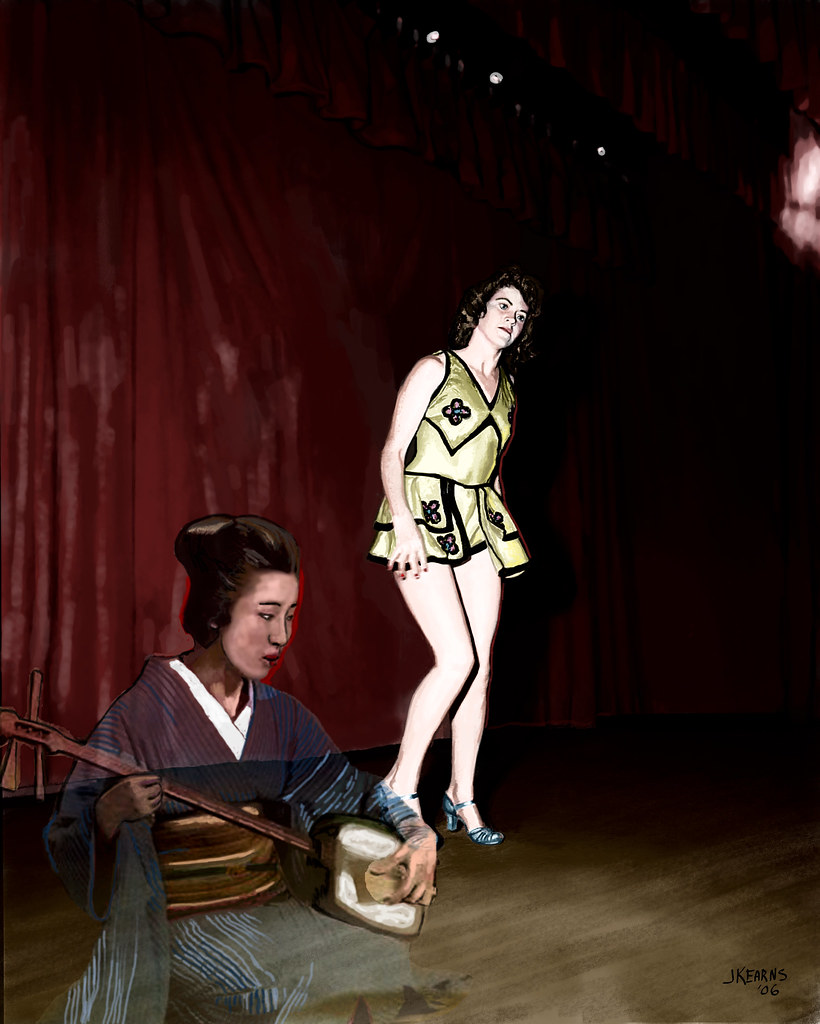
Hanford Tap Dancer, Declassified
Digital painting
2005-2006
Original photo from the "Hanford Historical Photo Declassification Project".
Read the introduction to the Remixing the Hanford Declassified Project paintings
The woman in the photo is a participant in a WWII talent show at the Hanford Theater. My assumption is she is tap dancing. Tap dancing was popular then and remained popular into my childhood. There was always a tap dancer on the Ed Sullivan Show in the 60s. Whether she's concentrating or uncomfortable is difficult to tell. Either she is focused on and straining to push out those beats and has forgotten to smile or she's not the first act and knew before taking the stage she didn't have a chance, that it was a senseless exercise , but the show must go on and while it runs her legs begin to feel too long, too naked, too short, too heavy, her feet sweat, her hands sweat, her shoulders chill, they prickle with goosebumps. She'd wanted to be Shirley Temple, Ginger Rogers, Ann Miller, but her time is up and she's on a stage sponsored by the atomic bomb rather than in Hollywood.
Or the photo could have been taken at a wrong moment and a couple seconds in the future she had blasted a hole in the floor with her mighty shoes.
But I doubt it. She reminds of the humiliated, red-head singer in Altman's Nashville, whose slumped shoulders begged the timid removal of her bra during a disastrous performance turned impromptu striptease, which had less to do with her pursuit of stardom and everything to do with submission to the demands of the group of wolves in which she found herself, then rationalizing a fair exchange afterward. Indeed, if I remember correctly, Altman had her dressed in a cape with hood. She was Suleen Gay, played by Gwen Welles, and one of the more heartening moments in film is when she returns home after the failed gig. Her friend, Wade, played by Robert Doqui, runs off the wolf who's carted her home, then risks Suleen's rejection when he tells her she can't sing and that her only pay will be to be abused and demeaned, her soul ripped to shreds if she continues. Suleen tells Wade that he's wrong, that she's been promised she'll be singing at the Parthenon and stalks off. Left alone on the steps of the apartment building, Wade says to himself, "I don't know why I stick around. She just makes me so god-damned mad." And it's not sad. Wade is a dishwasher who happens to be black and knows the game and Suleen is a white Red Riding Hood and it feels like one of the more hopeful relationships in a film where betrayal is the daily diet.
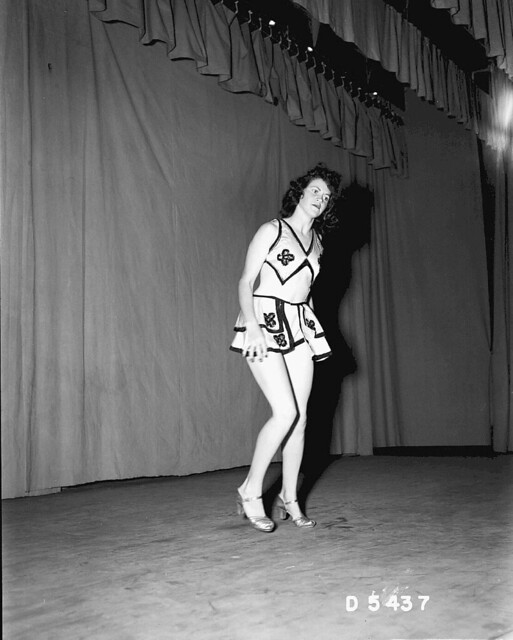
This photo of the tap dancer was numbered 5437. The photo of a group of black dancers was number 5347. Perhaps they were taken the same night.
DDRS Record Details for Record Accession Number
"N1D0024927"
Accession Number N1D0024927
Document Number D-5437-NEG
Alternate Document Number D-5437-NEG
Title Description WOMAN DANCING
Document Date 04-Dec-2001
Public Availability Date 14-Feb-2002
There are over 127,000 documents in the Hanford Declassification Project, and over 70,000 images. That means there are about 50,000 print documents. After some searching I don't believe anything is in there about the radiation survey to which I was subjected in the 4th grade along with my Richland schoolmates, nor have I so far found any pictures concerning it.
Hanford was part of the Manhattan Project, and as Oppenheimer directed the Los Alamos end where the bombs were manufactured, one would think there would be documents in the project concerning Oppenheimer, but a search only shows one document, dated November 1, 1944, and is a paraphrase of an October 1 teletype message sent to him. The document concerns the start-up of a reactor following a communication from Oppenheimer. It is largely illegible and seems to have been scanned without much thought given to legibility.
There are however pictures of dancers and a community going about what seems to be a mundane, daily life in which music played an important part, easing the stress of war.
Certainly music eased the stress of war on the other side of the Pacific Ocean, as well
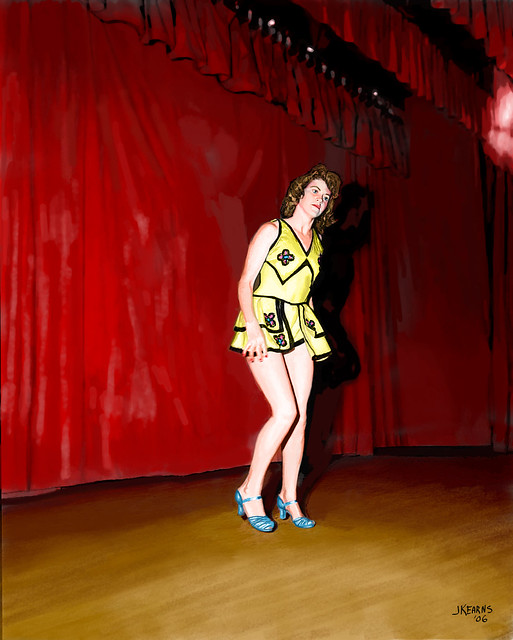
Originally I had just tinted the image. In the Winter of 2006 my husband had the pleasure of recording a world-renowned koto player of an age to have experienced WWII. While he was recording her, I pulled out this image, decided to paint it, and added the koto player.
Another version of the dancer:
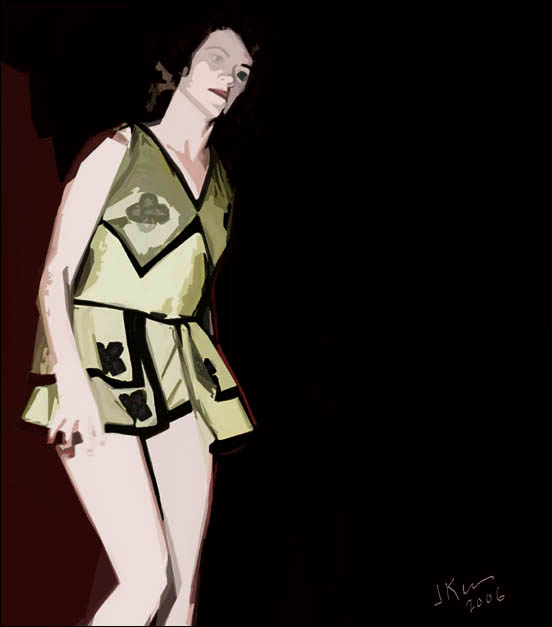
Originally published on my blog Oct 18 2005.
