

Hi Spot High School Dancers, Declassified
Tinted photo
Photo from the Hanford Historical Photo Declassification Project
Read the introduction to the Remixing the Hanford Declassified Project paintings
Teenage angst and love and fear and wonder at a blossoming new world.
The teenage wish to stand apart, to be individual, and the desire to identify with the pack.
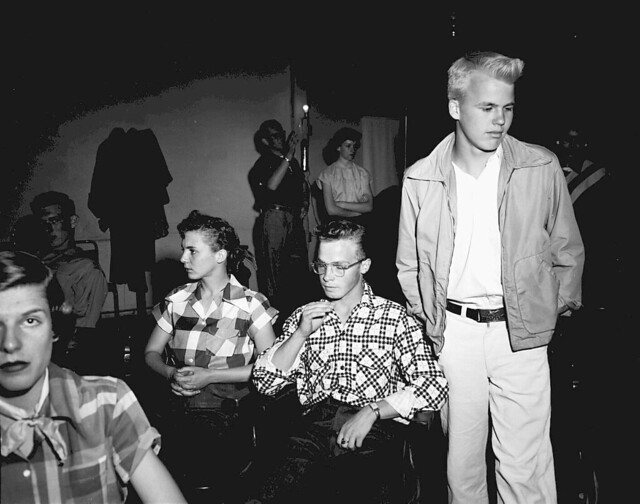
DDRS Record Details for Record Accession Number
"N1D0034663"
Accession Number N1D0034663
Document Number 1972-1-NEG-B
Alternate Document Number 1972-1-NEG
Title Description HI SPOT HIGH SCHOOL DANCERS
Document Date 04-Dec-2001
Public Availability Date 14-Feb-2002
The Hi Spot was a high school dance club.
The mascot of the Richland high school is a bomb, the students are known as The Bombers and the emblem of the school is a mushroom cloud.
Atom imagery was prominent in Richland. Such as When you went with your girl or guy to watch a movie you were watched over by the atom.
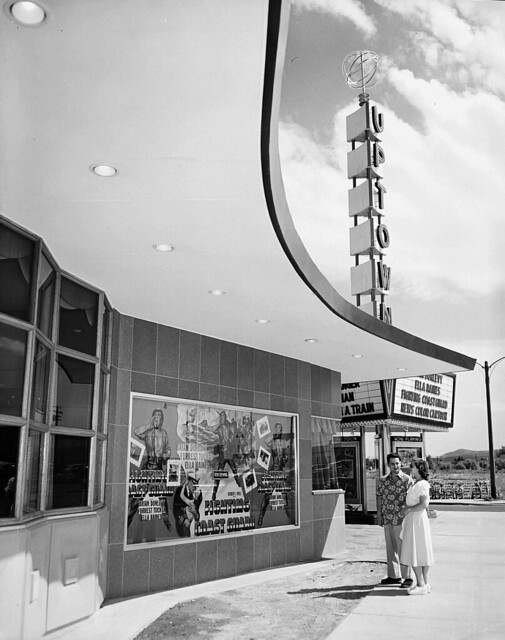
DDRS Record Details for Record Accession Number
"N1D0035615"
Accession Number N1D0035615
Document Number 2121-1-NEG-I
Alternate Document Number 2121-1-NEG
Title Description TRAILER CAMP -- SAFETY BILL BOARD -- RICHLAND UPTOWN DISTRICT
Document Date 04-Dec-2001
Public Availability Date 14-Feb-2002
There has been conflict as to the name, The Bombers. Some hold it was for Richland's part of the production of the plutonium that obliterated Nagasaki. Others say that the name was in honor of the B-17 Bomber, "Day's Pay", which was purchased by the employees at Hanford Engineer Works for the war effort, every employee contributing a day's pay. Joe Barber, a teacher in 1945 who became vice principal in 1946 and principal in 1947, says that the name was intended to honor the atomic bomb and Richland's roll in its production, which was only revealed after the dropping of the bomb, after which the change to the name Bombers.
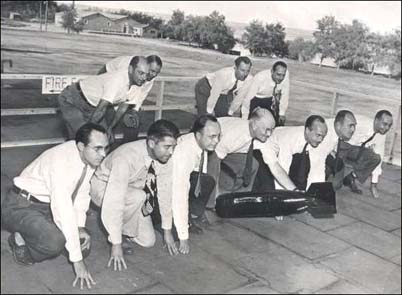
Cheerleaders, the mushroom cloud emblazoned on their chests, cart a bomb onto the field during games. They were carting the bomb onto the field at least in the early 50s. The mushroom cloud on the chest of the cheerleaders is a proud later addition, made during the 70s.
Here's a picture of some Hanford people playing football with the bomb.
A Japanese delegation visited the high school and asked for a name change. They were denied it. A name change has been put to vote and has been turned down. Many remain fiercely proud of the Bomber name and mascot, and protest any name change as ill-conceived political correctness that would deny them their pride in Richland's secret role in the building of the bomb which they believe contributed significantly to the end of WWII. As one such individual writes, "Plane or Bomb? Really what difference does is make? We're all Bombers and proud of our connection to the atomic bomb, and also proud of Day's Pay."
I look at the girl gazing toward the camera which was recording a moment that would be classified as secret for decades, and wonder if and to whom she married. Was it to the faceless boy? To what song were they dancing? If she is still alive, where is she now? What are her feelings on Brigadier General Bonnie Fellers' remark, made shortly after V-J Day, that, "Neither the atomic bombing nor the entry of the Soviet Union into the war forced Japan's unconditional surrender. She was defeated before either these events took place."
I wonder if the girl felt a moment's doubt on the righteousness of the bomb, would she swing back to belief out of loyalty to her school and its mascot?
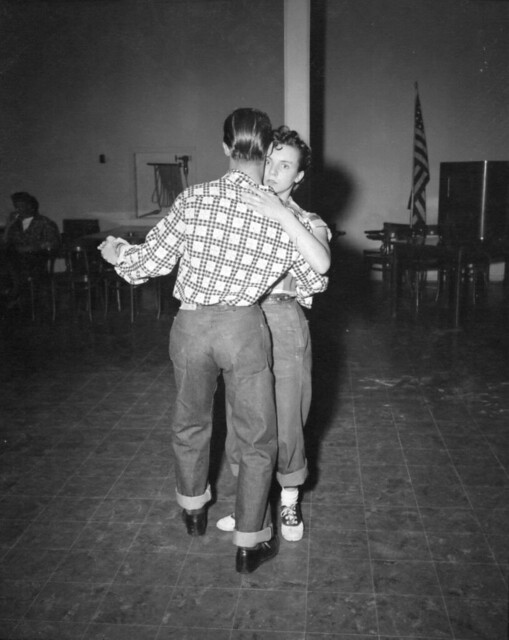
DDRS Record Details for Record Accession Number
"N1D0034658"
Accession Number N1D0034658
Document Number 1972-1-NEG-F
Alternate Document Number 1972-1-NEG
Title Description HI SPOT HIGH SCHOOL DANCERS
Document Date 04-Dec-2001
Public Availability Date 14-Feb-2002
Originally published on my blog Oct 18 2005.
