
Hanford Trailer City, declassified
2006
20 w by 13 in h
Digital Painting by Juli Kearns
Based on a photo from the "Hanford Historical Photo Declassification Project".
Read the introduction to the Remixing the Hanford Declassified Project paintings
The minimalist life Hanford style
Not everyone occupied with building The Bomb lived in the government-built Alphabet houses in Richland. Hanford Trailer City housed construction workers at the Manhattan Project's Hanford facility, with more than 3000 trailers and an average 3.7 people living in each trailer. At its peak occupancy, Hanford Trailer City had a population of 51,000 and was the 3rd largest populated area in Washington state. Those who arrived without trailers could opt to reside in barracks, but I imagine there were also trailers available for renting.
Where they lived
The below pics show the northern and southern portions of the Hanford Trailer City, but it's difficult from the images to grasp the gnarly, lung-destroying, dust bowl reality of what the Hanford Trailer City was like, for this was no ordinary desert. It was acres upon acres of land, the surface of which had been scraped barren by construction and the wind blew the unprotected subsoil far and wide.
DDRS Record Details for Record Accession Number
"N1D0030211"
Accession Number N1D0030211
Document Number P-6148-NEG
Alternate Document Number P-6148-NEG
Title Description HANFORD TRAILER COURT AREA - NORTH HANFORD
Document Date 04-Dec-2001
Public Availability Date 14-Feb-2002
DDRS Record Details for Record Accession Number
"N1D0029619"
Accession Number N1D0029619
Document Number P-3448-NEG
Alternate Document Number P-3448-NEG
Title Description HANFORD TRAILER CAMP - LOOKING SOUTH
Document Date 22-Jun-1944
Public Availability Date 14-Feb-2002
The model life
The model living/dining room was equipped with Better Homes and Gardens magazines so that the lady of the residence could take her discontented mind elsewhere.
The ashtray was conveniently placed atop the fire extinguisher.
DDRS Record Details for Record Accession Number
"N1D0066934"
Accession Number N1D0066934
Document Number S-1536-NEG
Alternate Document Number S-1536-NEG
Title Description CAMP HANFORD TRAILER
Key Word(s) HANFORD SITE,SAFETY
Document Date 05-Feb-2002
Public Availability Date 29-Sep-2002
This is your model kitchen, half a footstep from the model dining/living room.
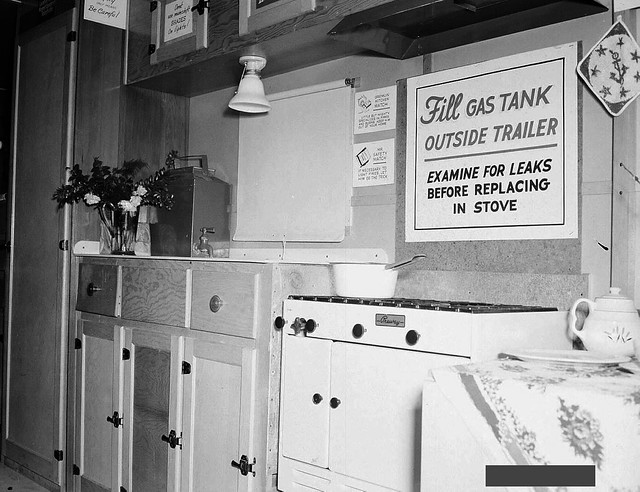
Title Description SAFETY SIGNS IN TRAILER
Key Word(s) HANFORD SITE,SAFETY
Document Date 05-Feb-2002
Public Availability Date 29-Sep-2002
The model life in miniature
Below is another kind of model trailer, made by a industrious Hanford resident.
You've no idea how much I would like to believe that model trailer still exists. I would love to own it.
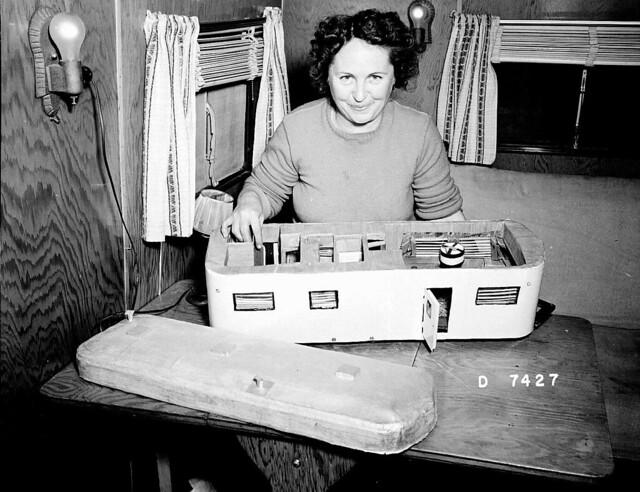
DDRS Record Details for Record Accession Number
"N1D0004861"
Accession Number N1D0004861
Document Number D-7427-NEG
Alternate Document Number D-7427-NEG
Title Description WOMAN WITH MODEL OF A HOUSE
Document Date 04-Dec-2001
Public Availability Date 14-Feb-2002
Some homes looked like this
Imagine 3.7 people living in each one of these matchboxes. Then imagine 3.7 people competing for the use of the outhouse.
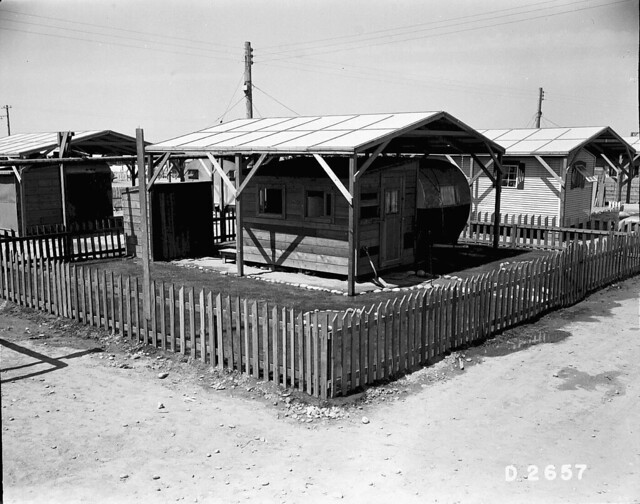
DDRS Record Details for Record Accession Number
"N1D0028847"
Accession Number N1D0028847
Document Number D-2657-NEG
Alternate Document Number D-2657-NEG
Title Description TRAILER LIVING, CAMP HANFORD
Document Date 04-Feb-1944
Public Availability Date 14-Feb-2002
Others like this
Some of the trailers were beautifully constructed and lavishly decorated.
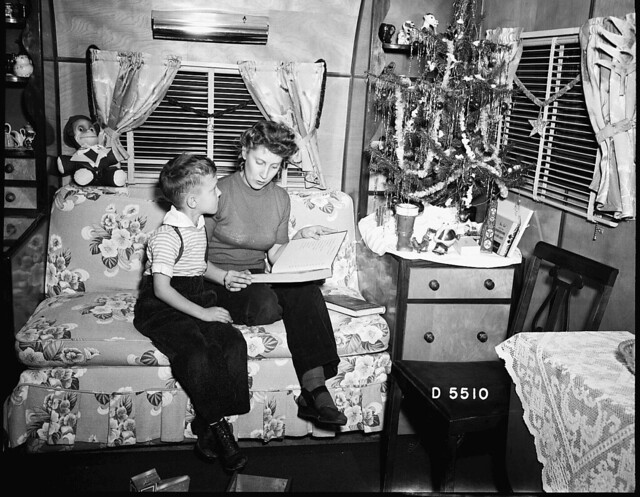
DDRS Record Details for Record Accession Number
"N1D0024977"
Accession Number N1D0024977
Document Number D-5510-NEG
Alternate Document Number D-5510-NEG
Title Description SAGE FEATURE - MOTHER IN TRAILER
Document Date 29-Dec-1944
Public Availability Date 14-Feb-2002
Some had carpet and came with cats who played nice with the fish.
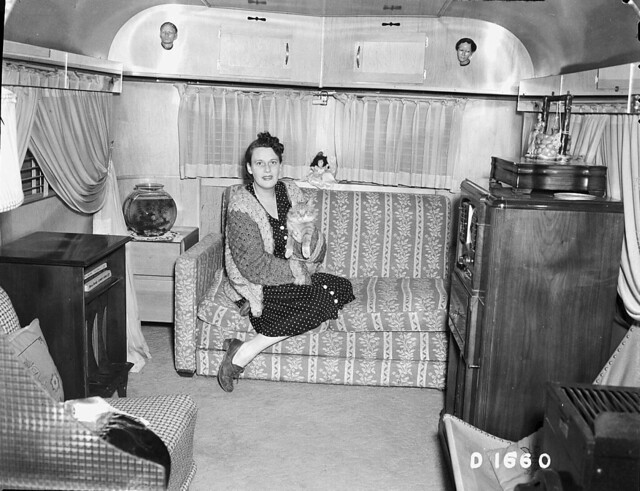
DDRS Record Details for Record Accession Number
"N1D0028736"
Accession Number N1D0028736
Document Number D-2272-NEG
Alternate Document Number D-2272-NEG
Title Description TRAILER LIVING - CAMP HANFORD
Document Date 04-Feb-1944
Public Availability Date 14-Feb-2002
Others had plotting dogs.
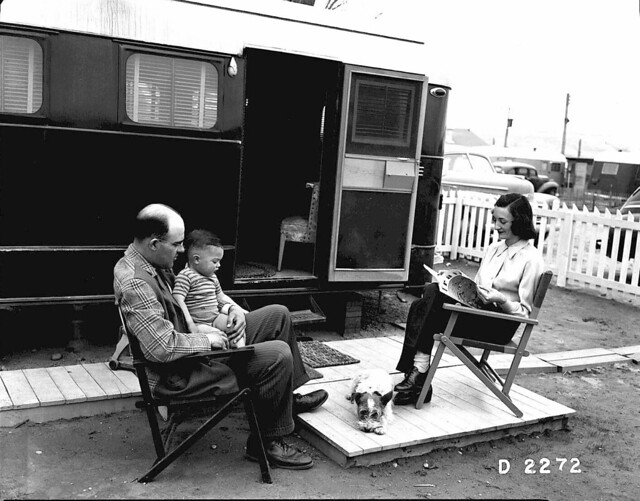
DDRS Record Details for Record Accession Number
"N1D0028736"
Accession Number N1D0028736
Document Number D-2272-NEG
Alternate Document Number D-2272-NEG
Title Description TRAILER LIVING - CAMP HANFORD
Document Date 04-Feb-1944
Public Availability Date 14-Feb-2002
And when everyone was settled in they all banded together for yet another safety parade complete with drum major, majorettes, and urchins looking askance
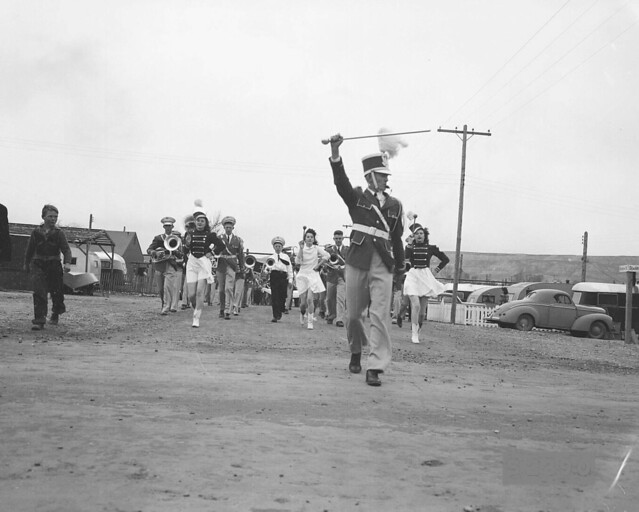
DDRS Record Details for Record Accession Number
"N1D0067001"
Accession Number N1D0067001
Document Number S-2290-NEG
Alternate Document Number S-2290-NEG
Title Description SAFETY PARADE
Key Word(s) HANFORD SITE,SAFETY
Document Date 05-Feb-2002
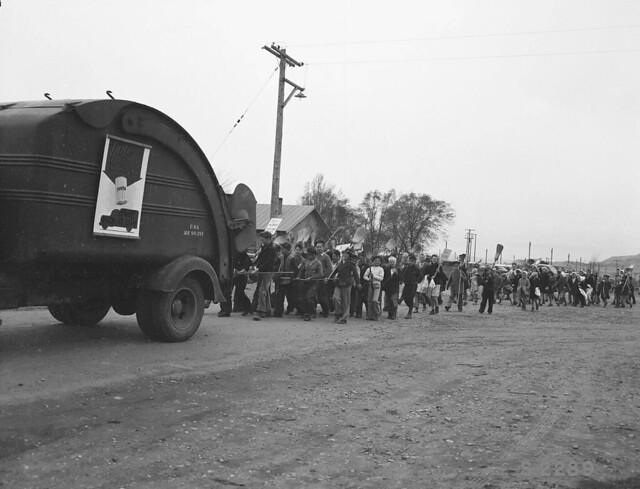
DDRS Record Details for Record Accession Number
"N1D0067000"
Accession Number N1D0067000
Document Number S-2289-NEG
Alternate Document Number S-2289-NEG
Title Description SAFETY PARADE
Key Word(s) HANFORD SITE,SAFETY
Document Date 05-Feb-2002
Public Availability Date 29-Sep-2002
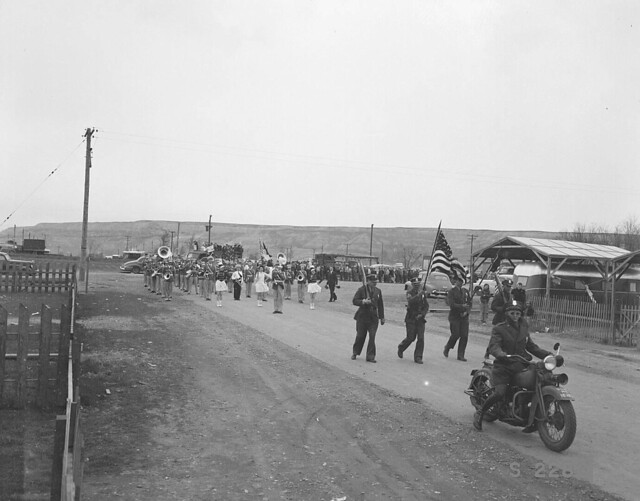
DDRS Record Details for Record Accession Number
"N1D0066991"
Accession Number N1D0066991
Document Number S-2280-NEG
Alternate Document Number S-2280-NEG
Title Description PARADE IN TRAILER PARK
Key Word(s) HANFORD SITE,SAFETY
Document Date 05-Feb-2002
Public Availability Date 29-Sep-2002
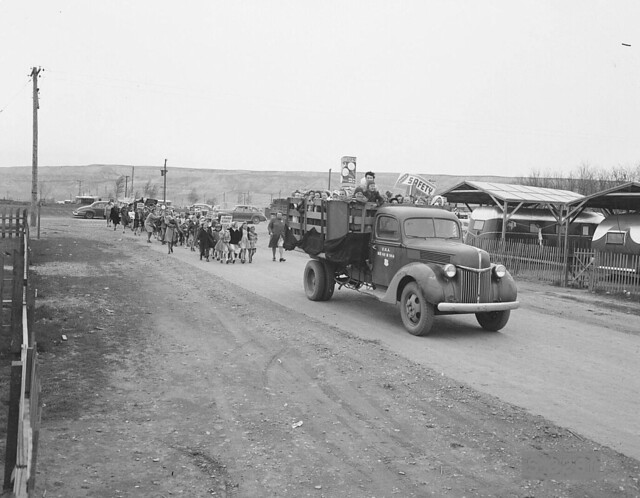
DDRS Record Details for Record Accession Number
"N1D0066992"
Accession Number N1D0066992
Document Number S-2281-NEG
Alternate Document Number S-2281-NEG
Title Description SAFETY PARADE
Key Word(s) HANFORD SITE,SAFETY
Document Date 05-Feb-2002
Public Availability Date 29-Sep-2002
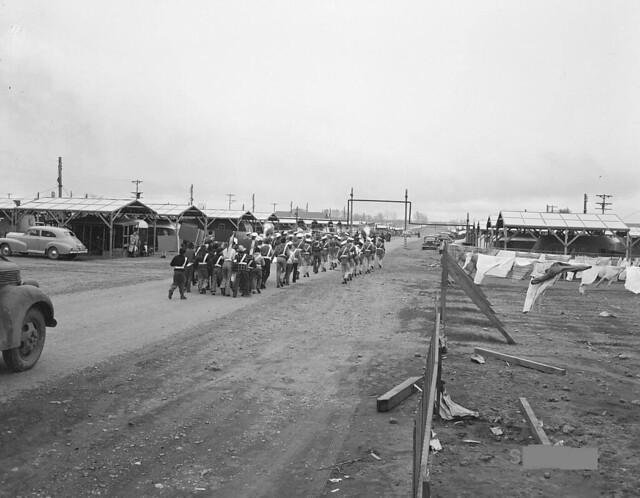
DDRS Record Details for Record Accession Number
"N1D0066996"
Accession Number N1D0066996
Document Number S-2285-NEG
Alternate Document Number S-2285-NEG
Title Description SAFETY PARADE
Key Word(s) HANFORD SITE,SAFETY
Document Date 05-Feb-2002
Public Availability Date 29-Sep-2002
Can you hear the 101 trombones fading into the distance?
With its duck decorated trellises and the white picket fence, the home I selected to paint begs, "Look, you can lead a miniature American Dream Life at Hanford in a veritable rose-covered Honeymoon Suite." They'd even a yard with grass.
But one wonders how people survived frigid winters and boiling hot desert summers in those trailers which had no air conditioning. One wonders too how these dwellings and sheds survived the dust storms that can roar through the area in the spring with wind gusts of up to 80 miles an hour.
In fact, it's said many opted not to weather the harsh conditions; that after a dust storm, a number of people would pick up and leave.
I well remember the violence of those dust storms in the 60s, the winds of which would grab a car door and slam it shut on your fingers. One time, when I was eight and walking home from school a dust storm unexpectedly blew up. A third-grader, I was small for my age, and the winds were strong enough that they were lifting me off the ground as I clung to a pole, when two girls from second grade, passing by, each took one of my arms and together we struggled down George Washington Way.
Weirdly enough you can become so used to those storms that you miss them. When I later visited Richland with my husband, as we strolled along the Columbia River the bright sunshiny spring day began to chill and dim. "A dust storm's rolling in," I told him. I wasn't absolutely certain one was, but I recollected how they were like this. How the weather could change in an instant and suddenly there would be a brown storm swallowing you. And I was excited that he was fortunate enough to have the experience of it.
Out on the range, those dust storms pick up radioactive tumbleweeds and carry them from here to there. I'm not sure where "there" is but seems to me that probably a number of radioactive tumbleweeds have rolled off the Hanford Reserve and down the road over the years. Efforts to corral and destroy the renegade weeds were eventually made.
The Cold War may be over, but the Hanford Nuclear Reservation continues to battle Russian invaders -- tumbling, radioactive tumbleweeds. Russian thistle is a dead menace here on the windswept desert of south-central Washington. Each winter, the deep tap root on the plant decays, and the spiny brown skeleton above ground breaks off and rolls away. "Our dream is that we have this place tumbleweed-free," says Ray Johnson, a biological control manager for radiation protection at Fluor Hanford, the contractor managing the U.S. Department of Energy site. But that's about as likely as a Soviet revival. While less than 1 percent of the tumbleweeds corralled and compacted at Hanford are radioactive, the ones that are cost a bundle to clean up.
Hanford is the most contaminated nuclear site in the country, built in 1943 for the top-secret Manhattan Project. For 40 years, Hanford would make plutonium for the nation's nuclear arsenal, including the atomic bomb that was dropped on Nagasaki, Japan. Russian thistle, a non-native or invader species, is a particular problem at underground burial sites for radioactive waste, where their tap roots reach down as far as 20 feet and suck up such nasty elements as strontium and cesium. A stiff winter wind can send the tumbleweed as far away as four miles, and then "we've lost control of our contamination," Johnson says. But most get hung up within a few hundred yards, usually on sagebrush, fences or in stairwells at the buildings scattered across the site. Two years ago, uncontrolled contamination spread by fruit flies at the site made Hanford a national laughingstock, spoofed by humor columnist Dave Barry and in the syndicated comic strip, "Sylvia." The flies had been attracted to a soil fixative with saccharin in the base that was being sprayed on a contaminated site. They flew to a lunch room and spread the taint to nearby Dumpsters, which wound up at the Richland municipal landfill. Johnson can laugh -- a little bit -- about it now, recalling attempts to find the source of the contamination. As crews ran radiation detectors around the lunch room, and passed over a fruit fly, "the contamination flew away," he recalls. The journeys of a few thousand fruit flies cost $2.5 million to clean up. Riding herd on Hanford's tumbleweeds, and its flying insects, is part of an annual $4 million integrated soil, vegetation and animal control (ISVAC) program, run by DynCorp. for Fluor. Radiation control specialists survey the tumbleweeds on the 560-square-mile reservation, using Geiger-Mueller counters that click when radioactivity is present. If contaminated tumbleweeds are found, an ISVAC crew is called in for disposal duty. "The weeds are fairly low danger," says Todd Ponczoch, a radiation control technician, scanning tumbleweeds along a fence line with a Geiger counter. None was registering as radioactive on a recent trip. A large, three-pound radioactive tumbleweed might measure out at 150 millirads, or about 1/100th of the allowable annual dose of radiation per person at Hanford...
- Source: http://web.cecs.pdx.edu/~bart/decrypter/DecryptDemo/plain5.txt
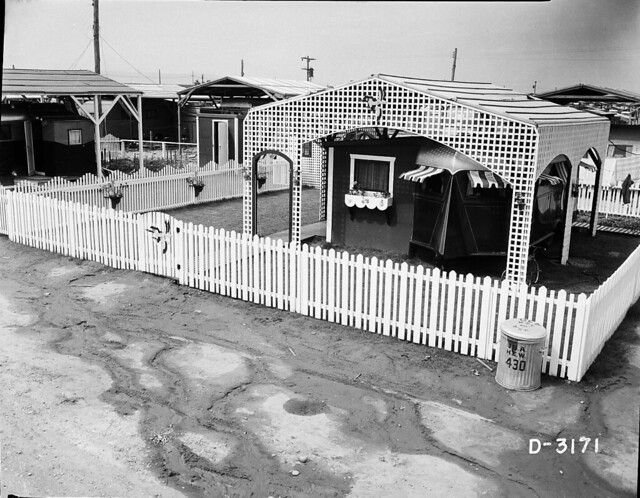
DDRS Record Details for Record Accession Number
"N1D0029138"
Accession Number N1D0029138
Document Number D-3171-NEG
Alternate Document Number D-3171-NEG
Title Description TRAILER LIVING, CAMP HANFORD, CIRCA 1944
Document Date 04-Dec-2001
Public Availability Date 14-Feb-2002
Originally posted on my blog June 18 2006.
