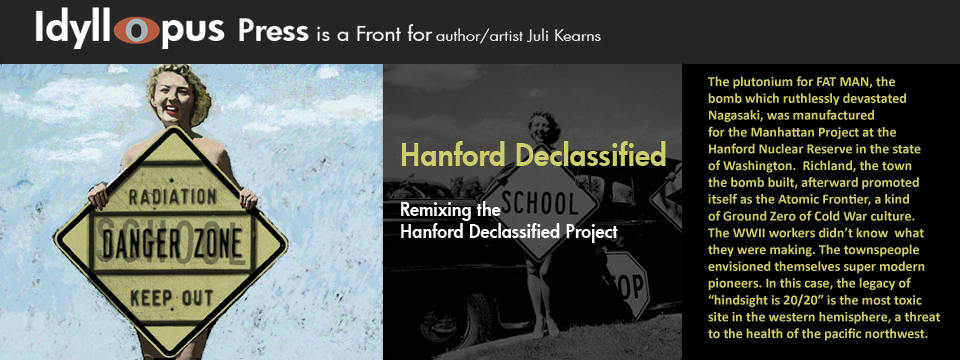

Gun-toting dancer, Declassified
Based on a photo from the "Hanford Historical Photo Declassification Project".
copyright J Kearns 2006
Read the introduction to the Remixing the Hanford Declassified Project paintings
The couple dancing is from one of the Atomic Frontier Days festivals celebrating the friendly merging of a gun-toting old west with the glorious nuclear future.
The photo of the sign collaged over the couple is one of many photos of signs in the Hanford Declassified archive.
They depict the real Atomic Frontier
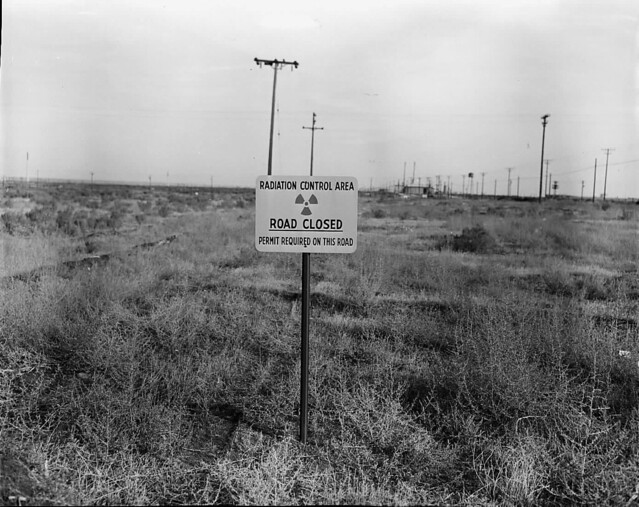
DDRS Record Details for Record Accession Number
"N1D0036941"
Accession Number N1D0036941
Document Number 12408-NEG
Alternate Document Number 12408-NEG
Title Description RADIATION ROAD SIGNS
Key Word(s) HANFORD SITE,RADIATION ROAD SIGNS
Document Date 11-Nov-1954
Public Availability Date 14-Feb-2002
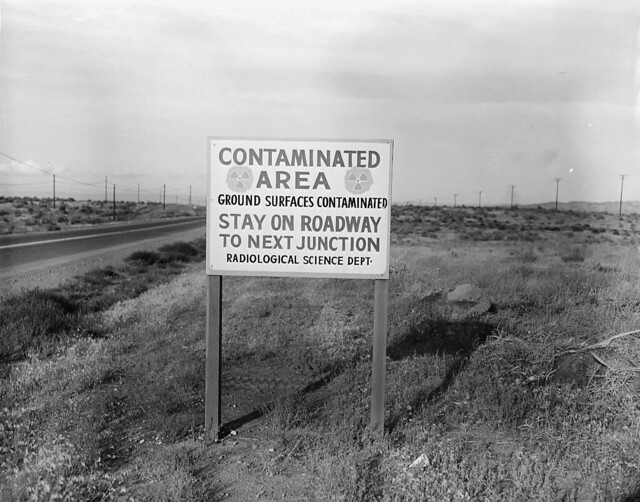
DDRS Record Details for Record Accession Number
"N1D0036943"
Accession Number N1D0036943
Document Number 12408-NEG-D
Alternate Document Number 12408-NEG
Title Description RADIATION ROAD SIGNS
Key Word(s) HANFORD SITE,RADIATION ROAD SIGNS
Document Date 11-Nov-1954
Public Availability Date 14-Feb-2002
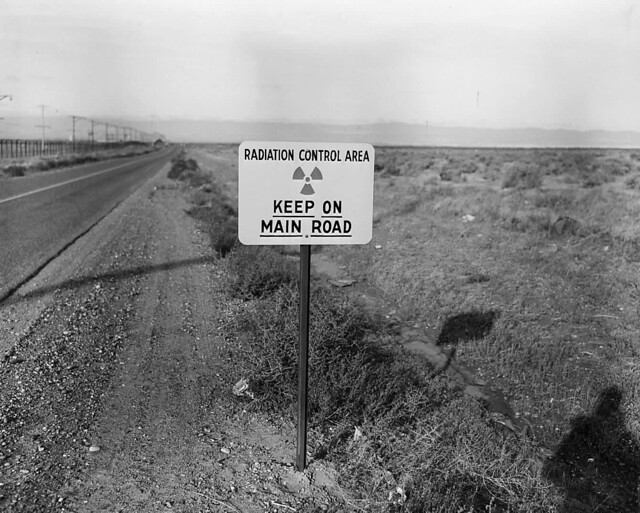
DDRS Record Details for Record Accession Number
"N1D0036944"
Accession Number N1D0036944
Document Number 12408-NEG-B
Alternate Document Number 12408-NEG
Title Description RADIATION ROAD SIGNS
Key Word(s) HANFORD SITE,RADIATION ROAD SIGNS
Document Date 11-Nov-1954
Public Availability Date 14-Feb-2002
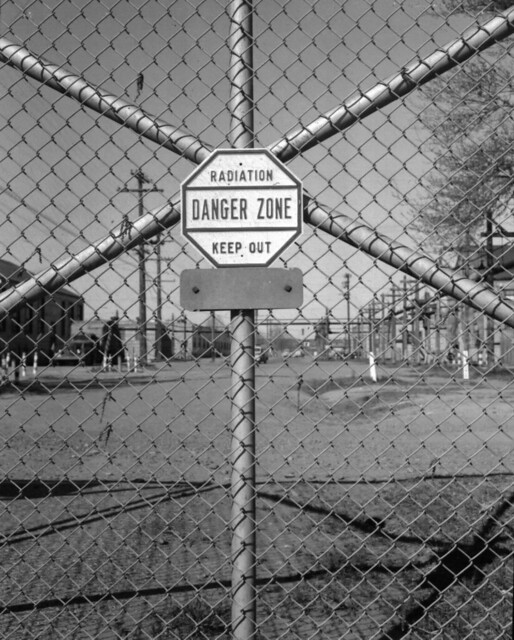
DDRS Record Details for Record Accession Number
"N1D0034440"
Accession Number N1D0034440
Document Number 1927-1-NEG-A
Alternate Document Number 1927-1-NEG
Title Description RADIATION SAFETY SIGNS
Document Date 10-Apr-1951
Public Availability Date 14-Feb-2002
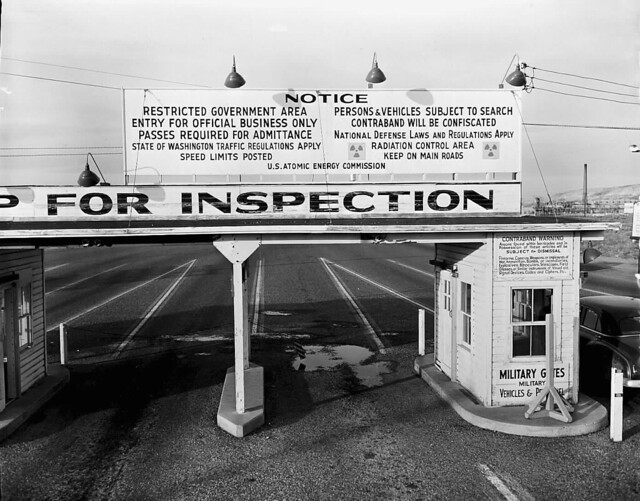
DDRS Record Details for Record Accession Number
"N1D0036938"
Accession Number N1D0036938
Document Number 12408-NEG-C
Alternate Document Number 12408-NEG
Title Description RADIATION ROAD SIGNS
Key Word(s) HANFORD SITE,RADIATION ROAD SIGNS
Document Date 11-Nov-1954
Public Availability Date 14-Feb-2002
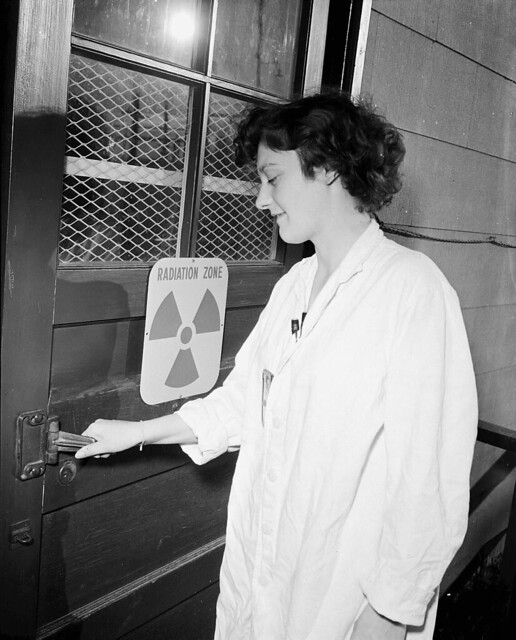
DDRS Record Details for Record Accession Number
"N1D0027328"
Accession Number N1D0027328
Document Number 8027-1-NEG-D
Alternate Document Number 8027-1-NEG
Title Description 300 AREA LABS - PENCILS AND BADGES, RADIATION SIGNS
Document Date 07-Dec-1953
Public Availability Date 14-Feb-2002
Problem is, not all the radiation stayed right there, fenced in by the signs. It was released in the water, carried on the wind. And over the years it has leaked out of tanks and into the aquifer that feeds the Columbia River.
At the nuclear weapons factories, immense quantities of radioactive and toxic chemicals were poured directly into the ground. Unbelievable as it seems today, millions of curies of radioactive materials and tons of toxic chemicals were poured into drainage ditches, seepage and evaporation ponds, and unlined burial grounds. This practice continues to the present day at Hanford. From these unstable disposal sites, contaminants have quickly migrated to surface and subsurface water systems. Sometimes these contaminants were even directly poured or injected into underground bodies of water. This was not an accident. It was deliberate government policy that was consistent with the DOE "solution" to radioactive waste management: dilution. Page 3
Dilution has always been DOE's preferred method for solving many waste problems. Often concentrations of contaminants in groundwater at the site perimeter are reduced due to dilution. Thus it appears as if the area is not heavily contaminated and makes it easier for a nuclear factory to meet regulatory guidelines regarding off-site emissions. From a public relations standpoint, out-of-sight-out-of-mind is certainly attractive. However, as contamination spreads, more people are affected. According to prevailing scientific opinion, the total dose to the population is the important parameter. The linear no-threshold hypothesis holds that a dose of 100 rems to 100 people (1 rem per person to 100 people) or to 1000 people (0.1 rem per person to 1000 people) produces the same number of fatal cancers. Thus, dilution does not necessarily lead to fewer occurrences of cancer.
Furthermore, dilution does not take into account the fact that diluted radionuclides will travel long distances downstream from the point of release and reconcentrate in mollusks, fish, bird and other creatures that could be subsequently eaten by unsuspecting humans. For example, radioactively contaminated mussels have been found in Oregon, near where the Columbia River empties into the Pacific Ocean, more than 200 miles downstream from the Hanford complex.
Neither does dilution address the problem of radionuclides adhering to sediments along waterways such as riverbanks and streams. Subsequently, when water levels drop (for example during a drought) dangerous contaminants can be resuspended and travel in the direction of the prevailing wind.
Perhaps nowhere is DOE's dilution policy more alarming than in the contamination of underground water. This is contamination that is almost impossible to map accurately and for which current technology does not allow for the complete cleanup. Yet these aquifers are a vital part of the nation's water supply. Carbon tetrachloride, chromium, nitrates, tritium, iodine-129, uranium, strontium-90 and plutonium-239 and 240 are some of the identified pollutants in groundwater at Hanford. The Snake River aquifer in Idaho has been contaminated with TCE, tetrachloroethene and other hazardous materials. For the first time in 2000, plutonium was also detected in two separate places in the aquifer. Uranium is the principal contaminant found in Ohio's Great Miami Aquifer. This is one of the radionuclides that can be removed by pump- and-treat, but groundwater moving off-site remains a serious concern.
DOE reliance on dilution continued long after information on the harmful effects of radiation was available. At Hanford, DOE estimates over 444 billion gallons of wastes were poured directly into the cribs, ponds, and trenches in the vadose zone beneath the reprocessing areas before this practice was stopped. Since reprocessing operations ceased, an underground mound of contaminated groundwater formed and is now spreading out and migrating out into the environment. Over 200 square miles of groundwater beneath Hanford are now contaminated.
Unfortunately, Hanford's practice was not isolated. Similar practices prevailed at Fernald, Oak Ridge, Lawrence Livermore, Paducah, Portsmouth, Rocky Flats and the Savannah River Site.
Source: Alliance for Nuclear Accountability - www.ananuclear.org
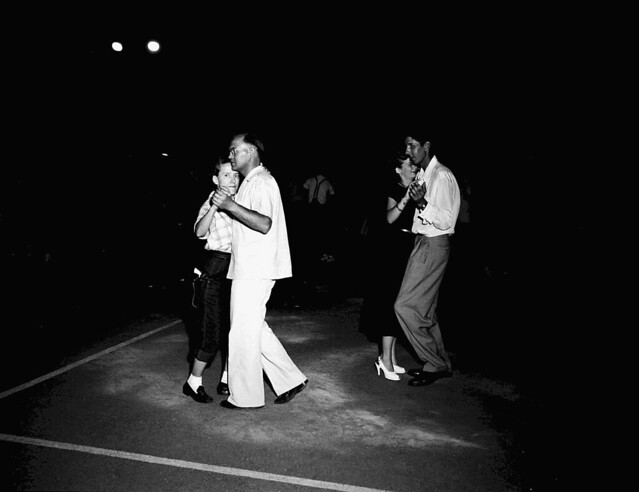
DDRS Record Details for Record Accession Number
"N1D0053764"
Accession Number N1D0053764
Document Number 1253B-50-NEG-37
Alternate Document Number 1253B-50-NEG
Title Description ATOMIC FRONTIER DAYS - PARADE, FIREWORKS, BEAUTY CONTEST, FLOATS, DANCING
Key Word(s) ATOMIC FRONTIER DAYS,BEAUTY CONTEST,FIREWORKS,FLOATS,PARADE
Document Date 05-Feb-2002
Public Availability Date 14-Jun-2002
Originally posted on my blog May 22 2006.
